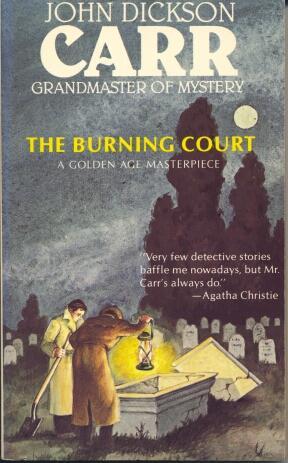
Miles Despard lies dead, a victim of gastroenteritis – apparently. But why was a woman wearing period dress seen in his bedroom on the night of his death, a woman who left the room through a door that wasn’t there? His neighbour, Edward Stevens is interested when Despard’s nephew, Mark, tells of his concerns, but is rapidly distracted by the book he is editing.
The book concerns historical poisoners, notably Marie d’Aubray, who was burned for her crimes in 1861. The manuscript contains a photograph of d’Aubray, a woman who is the spitting image of Edward’s own wife, but the photograph soon disappears… as does Despard’s body from his sealed crypt…
Yup, that’s the same blurb when I wrote when I reviewed this six years ago, but it’s been re-released by the American Mystery Classics range and, more importantly, it’s been chosen by my Book Club as this month’s title. Not sure you should read that review, to be honest, as there’s a little whiff of a spoiler in it. And this is probably a book that should be read as cold as possible.
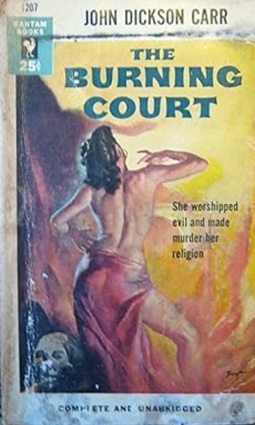
What I find interesting is that I clearly loved this the first time I re-read it. If I recall, the first time I read it (more than fifteen years ago), I thought it was good, but nothing special, the first re-read (six years ago) I liked it a lot better, this time, going in remembering some key things… well, I’m a bit on the fence.
First of all, I should say this is a deserved classic. The set-up is gripping and the denouement is enthralling. Once a certain character arrives on the scene, the book springs into life – but you can only spring to life if… well, you know.
The middle section seems to consist of long sessions of people talking about heir theories. And it goes on. And on. And on. Admittedly, it didn’t seem to bother me on my first readings but this time, it really seemed to drag. The character I mentioned appears a lot later than I recall, so maybe it was the expectation that was bothering me.
Anyway, this is a deserved classic, even if the villain is a bit of an idiot, and yes, the ending does work. I know it annoys some people, but it’s a brave experiment that Carr succeeds in pulling off.
 In Search of the Classic Mystery Novel