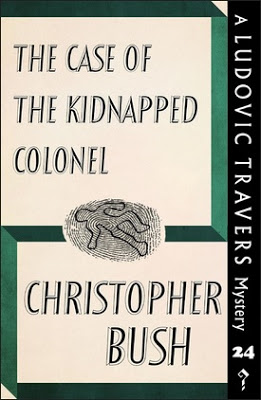
 Major Travers has been transferred from the prisoner of war camp at Shoreleigh (see The Case Of The Murdered Major) to Camp 55 in Derbyshire, an important locale for military research and development, based around Dalebrink Park, the home of Colonel Brende. The hunt is on for a way to counter the night attacks by the Luftwaffe, but problem abound.
Why is Penelope Craye, a former Nazi-apologist, allowed free access to the compound? What are the true motivations of the left wing New England Group? And who managed to sneak inside the compound to kidnap Major Brende – and how was a military man taken so easily? And when murder strikes, it falls to Travers and Superintendent George Wharton to find the truth.
The second of Christopher Bush’s trilogy of wartime mysteries – and again, this is a mystery rather than a spy thriller – and another book to look at in my “Do Mention The War” series of reviews. I mentioned Bush’s experiences that he drew from in the previous review, and again we get an investigation involving what appears to be a look behind the scenes of the military operation in England, this time seeing a bit more of the reaction of the man in the street, notably the pacifist NEG group, along with a sympathetic portrayal of one of the scientists, a refugee from Prague.
 Again, this really isn’t a propaganda piece as a number of the military officers aren’t portrayed in that positive a light, although at least one of them develops more positively as the tale progresses. What it would have done for the man in the street is humanise the military operation somewhat. I have no idea how much knowledge was being given to the general populace as to what happened behind the scenes, so I suppose you could argue that this filled that purpose. And of course it also served as solid entertainment.
The series transitions in this book to first person narration, as we get Travers telling us the story (and apparently all subsequent books) and as with the previous title, his actual detection gets dialled back as Wharton does a good chunk of the sleuthing. It’s a fun mystery, one of those ones where I feel in hindsight that I should have spotted what was going on but didn’t – which actually comes close to my definition of a perfect mystery. Travers’s voice is entertaining and there are plenty of twists and turns in the plot.
One thing that I found for the first time – the use of blitz as a verb – “we’ve been pretty well blitzed” – is something that is new to me. In fact, I wasn’t really aware, consciously at least, that the word “blitz” was used nationwide, rather than just the attacks on London. Oh, and apparently there was a magic act (or possibly two) going by the name of “Bill Bye and the Heathen Chinee” – not something that would happen these days, obviously.
One thing: don’t read the blurb on the back of the book. The murder victim – it happens relatively late in the book – works better as a surprise. Just take my word for it that this is Highly Recommended and read it sans blurb.
 In Search of the Classic Mystery Novel
[…] The Case Of The Kidnapped Colonel by Christopher Bush – more fascinating wartime detail, another equally fascinating mystery […]
LikeLike
[…] Case Of The Murdered Major) and a murder while in charge of a research and development enclave (The Case Of The Kidnapped Colonel), he finds himself transferred to Derbyshire to help train the local Home Guard. And there isn’t […]
LikeLike
[…] It is worth mentioning too the Travers wartime trilogy, namely The Cases of the Murdered Major, Kidnapped Colonel and Fighting Soldier, three mysteries that draw on Bush’s wartime experiences to give the […]
LikeLike