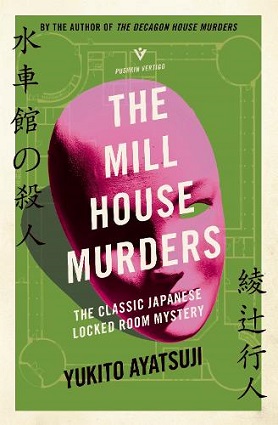
The Mill House is a remote mansion, home to the reclusive Fujinuma Kiichi, cursed by a disfiguring car accident to spend his life in a wheelchair and wearing a white rubber mask to hide his scars. And every year, on the same day, a small group of individuals arrive at the house to view its art collection, all created by Kiichi’s father. But last year, things were different. A painting was stolen, two people were murdered and the culprit disappeared without trace from a locked room.
One year has passed and the survivors meet up again. This time however, there is an extra visitor – the detective Kiyoshi Shimada. He has arrived to find out the truth about what happened a year ago, as he knew the person who vanished and can’t believe that they would turn their hand to murder. But you know what happens in such stories when you try and dig up the past…
You may have come across the author Yukito Ayatsuji by the translation of The Decagon House Murders, one of the best of the available translations from the shin honkaku school – note, I think this is shin honkaku rather than honkaku as I think the only difference is the date of writing. That first appeared an age ago via Locked Room International and then by Pushkin Press. They’ve followed it up with this, the second in what Wikipedia refers to as the Bizarre House Murders series. I’ve been looking forward to it for the simple reason is that I’ve found a lot of the honkaku titles that I’ve read somewhat lacking, but given that I enjoyed The Decagon House Murders, I had high hopes.
And…
… it’s a step down from that one.
Read purely as a logic puzzle, it’s all rather clever. The construction of the mechanics of the mystery provide a simple solution to what appears to be a complex problem – something that I always want to see in a mystery novel. It follows one of the more unfortunate standards of Golden Age detective fiction in that some of the supporting cast are just… well, there, without really contributing much to the plot. But as I said, that’s not unique and hardly a deal-breaker.
The problem is… well, this is going to be tricky. There is no way that I can explain my problem with the narrative without spoiling it for the reader who hasn’t read it yet. Aargh, let’s think about this…

OK, not going to even hint at why, but I knew – not suspected but 100% knew – who the killer was by the end of chapter four. I hoped against hope for something clever, but no. I get the feeling that the reader is supposed to get to the end and gasp something like “But what? How? My word, how clever!” whereas my gut feeling is the response of any armchair sleuth would be “Is that supposed to be clever?”
I’m torn – there were parts that I really liked, but as a whole, this was a bit of a let-down.
 In Search of the Classic Mystery Novel
I almost never even try to solve the puzzle despite reading almost all GA puzzle mysteries (yes, I’m weird that I don’t try) but, yeah, I agree that I figured it out really almost right away. And I thought that the format of the back and forth in time was going to put me off. But…that being said, I blew through this and really enjoyed it…without being able to articulate exactly why…
LikeLike
I’m planning on reading book 1, and maybe then stop there
LikeLike
I actually preferred this book to the first one. I have reviewed Decagon House Murders at https://www.goodreads.com/review/show/1338850612 where I have rated it as only 3. I found a basic flaw in the plot (mentioned in my review) and the writing style forced and awkward.
The writing style of Mill House Murders is much better and I rate it as 4.
LikeLiked by 1 person
I’m probably very unusual among your readers, Puzzle Doctor, in that although I enjoy the puzzle it’s not a massively important factor for me, and I’d sooner have a lot of atmosphere and suspense and action scenes than pure logic. That’s why of the Japanese mysteries I’ve read, any predictability doesn’t bother me all that much. I may still give this one a go on that basis.
LikeLike