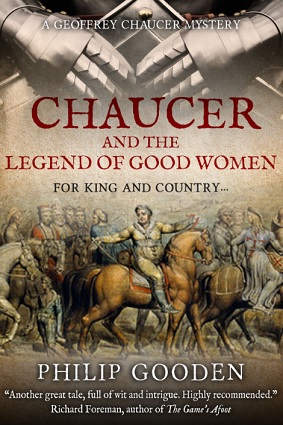
The spring of 1373, and Geoffrey Chaucer (yes, that one) is on a journey to Italy on secret business for the aging Edward III of England. The crown needs a load to maintain England’s ongoing war against the dastardly French, and the banking house run be Antonio Lipari should be just the ticket. Lipari has indicated that it is all but a done deal, but many people seem to be opposed to the deal – or just opposed to Lipari in general.
As many people with grudges converge on the banking house, tragedy strikes – eventually – and Chaucer himself finds himself the target of some mercenaries. Can he get to the bottom of the complex case and arrange the loan that the King needs?
So, at the second attempt, an author who is new to the blog. Philip Gooden has written a number of historical mysteries – four in this series, three Victorian Cathedral-based mysteries and six Shakespearean mysteries. I think that’s it – it’s very hard to find a bibliography online – but he’s not an author that I’ve reviewed… oh, Zeus be damned, yes I have. Sort of.
Gooden is one of the contributors to The Medieval Murderers anthologies, one of which I’ve reviewed – The Tainted Relic – and looking back at that review, I see that his section was the one I least enjoyed. But that included the characters from his Shakespeare series, so I hoped that this one would be a better one to try – yes, I had already remembered that I’d read a bit of him.
And… well, as a mystery, this is not something I can recommend. It’s far more a story about a complex crime and the characters that it involves rather than a whodunnit, despite it being presented as such. The murder takes an age (c. 55% of the book) to happen, with various chapters following various characters’ paths to the victim and the night of the crime. That’s strike one, and you can add in strike two, because if you follow three or four characters with obvious motives, well, people who’ve read a lot of mysteries know what that tells you. Strike three is the murderer doing something incredibly unlikely and strike four is Chaucer somehow deducing this thing (which someone surely would have realised before now) and rationalising that this act makes the character the murderer, despite there being no necessary parallel. Oh, and strike five is the killer being unmasked due to going a bit nuts and trying to kill someone – Chaucer’s rationalisation comes after this fact.
As for the historical side, it didn’t particularly grab me. I was pretty bored by the plot, so I was hoping the historical detail would enliven it for me, but it’s got some decent detail, but comes across as quite factual. There’s a lot of historical literature – one title in particular is rather important – but that’s not something that really interests me. Oh, and the use of the phrase “get off with” struck me as anachronistic.
One last moan. I really didn’t like the bit when Chaucer is faced with the possibility of betraying his marriage vows, the reader is told that he did “what you would have done”. Which is fine, if it’s left unclear what he chose to do, but it isn’t, it’s made very clear a few chapters later. Glad to see the author has such a high opinion of his readers…
So, that’s it for this author. Going to try one more new author – a recommendation from Sergio – before returning to the safer ground of an old favourite.
 In Search of the Classic Mystery Novel