“Cranston and his friar are to be killed. But how, when, where, or by whom, I do not know.”
March, 1382. The Secret Chancery is the dark agency at the beck and call of the throne – or in reality, the regent John of Gaunt. They are the keepers and seekers of secrets, with agents everywhere. And the agents in Paris – agents whose identities are closely guarded secrets – agents who are all that stands between peace and war with France – are being killed by their counterparts in the French regime.
In London, the Chancery have a secure centre of operations – a labyrinth of locked doors and spiral staircases – but death strikes there too. Sir John Cranston and Brother Athelstan are in a race against time to uncover a traitor who can strike without mercy and has determined to most efficient way of eluding the friar’s keen instincts. Because Athelstan is the killer’s next target.
And so I bring September History month to a close the same way I opened it – with Paul Doherty and Brother Athelstan. Next time I try this, I’ll try a less busy month than the first in the school term, but I’ve got a load of recommendations. But this was, and Murdering The Messenger, was the inspiration for the theme month, so I was determined to include it. And let’s face it, I will always find the time to read a new Paul Doherty book.
It’s not out until early November, but I managed a whole month of having the preview e-copy without cracking it open – that’s pretty good for me. And it’s a fantastic way to end the month.
There’s more of an espionage theme in this one, as we almost seem to be treading into Hugh Corbett’s area, as Athelstan gets involved in the simmering not-quite-war with France. Of course, being an Athelstan mystery, there’s also the return of a cat-burglar who once stole a valuable ruby from John of Gaunt and a disappearing relic from Athelstan’s church. Both plots interweave with the main one with, as you might expect, some unexpected overlaps.
There’s also a new wrinkle, an adversary who takes the step that almost every classic mystery villain should but rarely tries, namely a concerted effort to murder the sleuth. This isn’t the “sleuth stumbles across a shadowy figure, has a bit of a tussle with them” but an active ongoing plot from someone who knows just how dangerous Athelstan and Cranston are. Spoiler – it doesn’t succeed, but the palpable sense of danger hanging over the tale is very effective.
And all the usual stuff is here – mysterious deaths, locked rooms, and the richest sense of history. There’s a line in the Author’s Note at the end: “I hope my novel has transported you back to those hurling days in the 1380s when England was swept by the strong winds of change.” Paul, if you read this, rest assured that it did. It’s not somewhere that I’d ever want to live, but I hope to keep visiting it in the company of the little friar for many books to come.
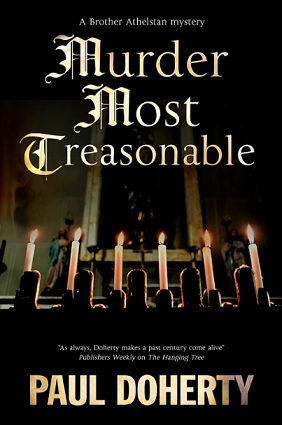
Murder Most Treasonable is out in early November from Severn House. Many thanks for the review e-copy.
 In Search of the Classic Mystery Novel