
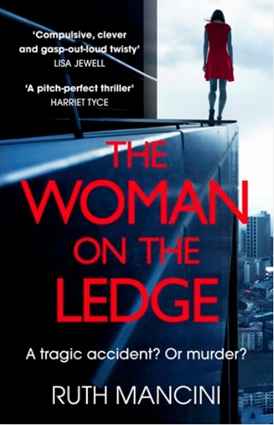
Tate Kinsella has been arrested on suspicion of murder. Her story is simple. She met the victim the previous night at the office Christmas party. She was threatening to jump from the roof on the twenty-fifth floor, and Tate talked her down. Tate says that she has no idea how the victim gained access to the bank the next day, and no idea why she jumped that time.
But Tate isn’t telling the whole truth – there is evidence incriminating her in the victim’s murder and huge holes in her story. Is somebody trying to frame Tate for the death? Or is somebody playing an even more complex game?
I’ve not come across Ruth Mancini before – I think this is her fifth book – but this caught my eye on NetGalley a while ago. The premise seemed intriguing so I figured why not give it a try? And I’m glad that I did.
We’re in unreliable narrator thriller territory here, flashing about through time as we start with the police accusation, then to Tate’s tale of what happened. And then someone pokes a hole in Tate’s narrative and she goes back and corrects/clarifies what actually happened. And then repeat that a few times until the full truth is revealed. It’s a bit like a reverse Columbo.
But that’s only the basic structure. There’s a complexity to the grand scheme, and all the layers of the story that we are given, that is very impressive – the author clearly spent a good deal of time working out the details, including the problems in the narratives that aren’t the full truth. It’s not a whodunnit, just to be clear, as we get the general shape of things fairly early on, but it’s more a game of “spot the error”.
And it’s also a tale of justice, tragedy, and the lengths you would go to get justice, and the personal aspects of the story are well done – believable and chilling. The details are not dwelt on, but that doesn’t mean we don’t get a feel for the effect the character’s actions have had on a number of members of the plot.
Any problems? Well, the nit-picky part of my brain felt that it was a pity that the structure – everything is told to us from Tate’s point of view, reliable or otherwise – is broken in one section of the narrative. Don’t get me wrong, this is one of the most effective parts of the book, and I can’t see any other way this part of the story could be effectively delivered, but, as I say, it’s a tiny bit of a shame that the structure has to break to include it. But it does need to be included, so fair enough.
So all in all, a strong start to my reading for this year. If you’re a fan of psychological thrillers but are concerned that there’s often not enough plot in them, why not give this one a go?
The Woman On The Ledge is out on January 4th in hardback and ebook from Penguin. Many thanks for the review copy.
 In Search of the Classic Mystery Novel