
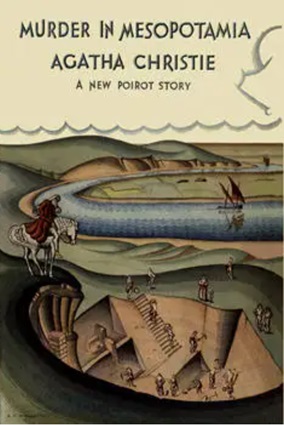
An archaeological dig near Hassanieh, Iraq, and Nurse Amy Leatheran has been hired by Dr Eric Leidner to care for his wife, Louise. Louise is apparently in fear for her life – letters have arrived threatening that she will be killed. These have plagues her since her first husband apparently died – is it possible that he still lives and is stalking her?
Soon the threats come true and Louise is found dead in her room in the complex – although there seemed very little opportunity for the killer to strike unseen. Faced with a near impossible situation, it’s rather handy that a friend of a member of the dig party is in the area – a certain M Hercule Poirot.
So we come to Poirot’s first adventure outside of Europe, and a contender for the most over-rated of his adventures. I’ve ranted on this one before, but as it’s part of my official Poirot Count-up, it’s time to make that rant official.
Let’s start with the good, first of all, and that’s primarily the narrator, Amy Leatheran. It’s interesting to get a non-Hasting narrator (and not in a tricksy kind of way) and one who isn’t immediately enamoured by Poirot. There’s one odd point where, given the narrative is written in the past tense, she describes a potential relationship as ideal, despite… well, knowledge of the end of the story makes what she writes very odd. All in all, though, it’s the most successful part of the story.
Poirot, by the way, is very un-retired at this point. He’s been on business in Iraq and has no qualms in taking on another case.
On the other hand, let’s look at the flaws:
- The suspects really are an uninteresting bunch. There never seems to be a tangible motive beyond “someone is Louise’s ex-husband or her son”. You’d think, I suppose, that if you’re wise to Christie’s tricks that this means that the villain is a woman, but it never gets even as interesting as that.
- She would have noticed, wouldn’t she?
- The practicalities of the murder method. Right, how to put it without spoilers? OK, best to skip this if you haven’t read the book…
… balls, going to have to spoil this. It really bothers me.
…you have been warned…
…right.
A brick building with a window with bars in it. How does one place a certain part of one’s anatomy in a position for something important to happen? Not just fitting it through far enough but then twisting it round? It just wouldn’t work convincingly.
So all in all, this is merely an adequate outing for Poirot – unlucky number 13…
Ranking Poirot (So Far)
- The ABC Murders
- The Murder Of Roger Ackroyd
- The Mysterious Affair At Styles
- Peril At End House
- Murder On The Orient Express
- Three Act Tragedy
- Lord Edgware Dies
- Death In The Clouds
- Murder In Mesopotamia
- The Murder On The Links
- Poirot Investigates
- The Mystery Of The Blue Train
- The Big Four
- Black Coffee
 In Search of the Classic Mystery Novel
I almost never see this one favorably evaluated, for pretty much the reasons you state. (And I agree.) How can it be “overrated”?
LikeLike
I was always under the impression it was looked on fondly. Maybe I was mistaken…
LikeLike
I enjoy this one only for the setting. The flaws you identify are legit. I like your ranking, although I personally put Styles below both Peril at End House & MotOE.
LikeLike
It has definite flaws, but I love it anyway. The murder method never bothered me as it does many readers. The imposter angle was too much to swallow.
LikeLike
The method only bothered me on the second reading, but it does mention (unnecessarily) that the window is barred. As it’s an old stone building with presumably thick walls (they are soundproof), it now really bothers me that the victim could get into a position to be murdered that way… And once it’s in my head, I can’t stop thinking it…
LikeLike
SPOILERS BELOW
If we look at this one merely for the puzzle, then yes – it has its problems. I want to look at that barred window before I agree with you about the logistics; still, it’s hard to imagine that Louise would go to the window and do what she does rather than run outside and check! The biggest issue is one of identity: no matter how much people age or get their faces mangled in a train wreck and come out looking like Humphrey Bogart in Dark Passage, it’s well nigh impossible to believe someone who has been sexually and emotionally intimate with someone for a significant period of time could not recognize that same person in the same situation.
But then . . . Louise Leidner is based on a notoriously frigid woman. Maybe they’re never intimate! Maybe the wild and passionate Frederick Bosner is really hard to see under the gentle sweetness of Dr. Leidner . . . naw, I don’t buy it, either!
But then . . . I think the setting and a lot of the trappings are terrific here. It’s the only time we get a fictional representation of Christie’s experiences on a dig. The murders are both atmospheric; Miss Johnson’s might be the more horrific of any death in the canon. And while the men are (as often happens in Christie) almost interchangeable with each other, ironically if you cross out the suspects most likely to be Bosner or his brother, you come up with some more interesting folks: the Mercados, Father Lavigny, Miss Johnson, the doctor’s sardonic daughter.
I don’t disagree with your placement, which is subjective and therefore fair. But as Rinaldo says, this one gets very little love these days, and I agree with Elizabeth that there is definitely stuff to enjoy here.
LikeLiked by 1 person
I remember many a time in chemistry class that we worked with hydrochloric acid and every time I couldn’t help but think of poor Miss Johnson.
LikeLiked by 1 person
The flaws are huge, I agree. Don’t think I gave ever re-read it in fact…
LikeLike