“God demands justice. I pray he gives it a helping hand.”
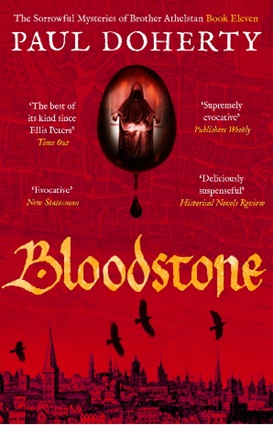
The Passio Christi, the sacred Bloodstone, formed apparently from the congealed blood of Christ as he bled on the cross, sits safely in a chest owned by Sir Robert Kilverby, the man entrusted to keeping it safe. It was seen being locked away, and then Sir Robert locked himself in the room containing it. Only Sir Robert had the keys to the chest containing the Bloodstone – but when the room is broken into the next day, Sir Robert lies dead, and the Bloodstone is missing.
Meanwhile at a nearby abbey, the Wyvern Company, the band of archers who retrieved the stone from France – possibly illegally by looting an abbey – are dying one by one. Is someone out for revenge, seeking to return the Bloodstone to its true home? But if the killer has the stone, why are the deaths continuing?
So, I was having trouble getting into a book – slight problem as I’ve got a lot of reviews due soon – so I went to my usual kickstarter, the Brother Athelstan mysteries by Paul Doherty. Let’s see what we’ve got here…
“The hogs feasted well. They ate the soft fat first, face, belly and thighs.”
Yes, it’s DEATH BY PIG! Actually, the victims were already dead – but Mr Pig and his friends did a very good job of disposing of the bodies… Oh, I’d missed Paul’s writing, it’s been too long!*
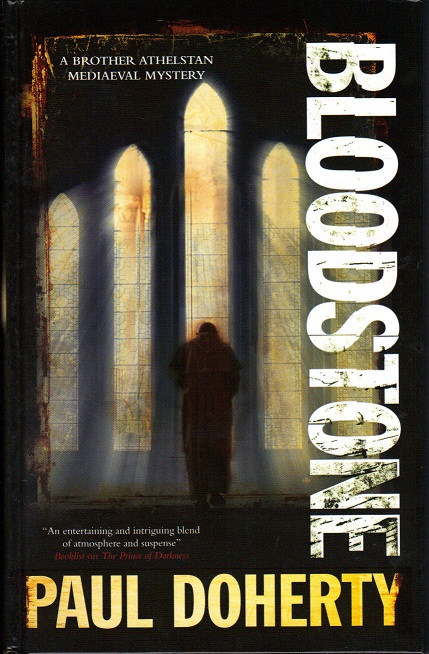
This was the first time Doherty returned to the little friar after an eight year break – and it was a very welcome return. I’ve no idea why there was such a break. He took a similar break from Sir Hugh Corbett, but unlike Sir Hugh, this picks up right where we left off, in a London on the verge of the Peasants’ Revolt. This story will play out over the next five novels, and beyond, it’s the perfect way to get a snapshot of history, another era that we never talk about in school.
This is a smashing tale, with an interesting reversal of one of Doherty’s usual tactics with regards the overall plot. The murder methods are clever and imaginative, with sufficient clues and hints as to what is going on, a plot that is both complex enough to intrigue and straightforward enough to figure out… bits of.
Athelstan quickly became one of my favourite sleuths when I started reading the series – other detective priests/monks can end up spouting homilies and forgiveness, whereas Athelstan, while still a man of God, is still a man of his time, a man who has seen death both on the streets of London and on the battlefields of France. He is a man who cares for his parishioners and for victims everywhere but has little time or forgiveness for those who willingly commit the multiple dark deeds around London. This is the book where the Peasants’ Revolt plot begins to move forward, as Athelstan begins to question where he stands and whether his parishioners, some of whom are already part of the conspiracy, can all be saved, no matter which way things go. It certainly beats subplots about the state of the lead detective’s marriage or whether he’ll get kicked off the force again.
This was exactly what I needed to jump-start my reading. If you haven’t met the good friar yet, I’d recommend heading back to the beginning with the excellent The Nightingale Gallery – the order isn’t essential, but there’s some mild continuity that you’ll appreciate more if you read them in order. It’s a bargain as an ebook, so what are you waiting for?
*Well, it’s been a little less than five months, which is a long time for me…
 In Search of the Classic Mystery Novel