“I saw a murder once.”
Young Joyce clearly has never seen a murder mystery before by announcing the fact that she had been a witness to a hitherto unknown crime. When she is found at the end of the party face down in the apple-bobbing, no one should have been surprised…
Ariadne Oliver, a guest at the party, immediately calls in Hercule Poirot to investigate the murder of the young girl, but the question is twofold – what murder did she witness and who killed her?
Reading Hallowe’en Party was out of the question for this Hallowe’en, as I’m only on the fifteenth Poirot chronologically (and Black Coffee which sort of counts). But I could still watch it…
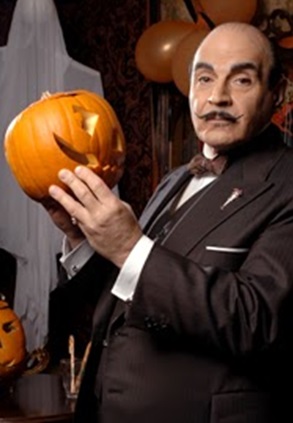
I thought it was time that I familiarised myself with some of the later Suchet adaptations, as I haven’t seen that many of them. And given the date, the obvious one to pick was this one.
Counting Curtain as the final book, this is the antepenultimate Poirot novel. Bookended by Third Girl and Elephants Can Remember, this has a reputation as one of the better of the later books, but while it has some nice ideas and dark moments, it’s also rather meandering. Personally, I prefer Third Girl…
I’ll be honest, I don’t recall a lot of plot detail from Hallowe’en Party. In some ways, it’s unfortunate that one of the few things that Kenneth Branagh kept in A Haunting In Venice was the name of the murderer – I had genuinely forgotten it, so when I watched that, I genuinely had no idea who was going to be guilty – so if you’re expecting a blow-by-blow list of all the changes, then you’re going to be disappointed. I’d recommend the Hallowe’en Party video on Miles Ledoux’s YouTube channel, as he does a good job of discussing them there.
What I can tell myself is that this is an excellent adaptation that certainly feels faithful to the original. Rather than introducing new plot points and changing existing ones, like the adaptation of Cards On The Table, anything new that Mark Gatiss’ adaptation brings in feels like it belongs, and most of that is tidying up Christie’s strands or making coherent links between the various threads. Suchet is on top form here, and there is a pleasing lack of the need from some of the later Poirot adaptations (Murder On The Orient Express for example) to fiddle around with his character. The supporting cast is very strong, with almost everyone in the house being a recognisable actor at the very least, and some of my favourites – Amelia Bullmore, Fenella Woolgar, Timothy West, for example – are there, which always helps these things. Julian Rhind-Tutt does a great job as Garfield, as does Mary Higgins as young Miranda. All in all, the cast is top-notch.
There are a couple of points though. Gatiss does a good job with the pacing of the reveals, but there is one point where a character is lying about what they saw and, while this might be a deliberate choice by the director or actor, but it sounds like they are lying. Hence it does point the finger at the killer a tad too early…
And this isn’t about the adaptation, as it’s in the book too, and it’s a bit of a spoiler… how can I phrase this without spoiling it? Let me think a mo…
OK, SPOILER WARNING…
Dropping a vase only gets your ankles wet.
Anyway, it’s good to see that after a few false starts, there are very good Poirot adaptations that I haven’t seen before. Anyone have any recommendations for those to prioritise/avoid?
 In Search of the Classic Mystery Novel
This is an odd book with a remarkably high body count! Some of the later Christies like this one, that are undeniably meandering, so I reckon they have benefited as narratives by tightening for the screen – and I think this is a good example of that on the whole. But I really like the Branagh/Green adaptation.
LikeLike
An interesting use of the word “adaptation”. I really enjoyed A Haunting In Venice but apart from some names and an apple bobbing bucket, there isn’t much overlap in plots at all. Not that this is a bad thing – maybe Green and Branagh can take over from Sophie Hannah – but I struggle to see many parallels between the book and the film.
LikeLike
Though the later Poirot adaptations are typically given a bad rap, I actually think quite a few of them make for very solid adaptations of the books. I am particularly fond of Three Act Tragedy which does a nice, subtle job of highlighting the theatrical setting of the novel in its execution. Five Little Pigs (arguably the strongest of all the David Suchet episodes), After the Funeral, Mrs. McGinty’s Dead, and Curtain are all definitely worth a watch. Controversially, perhaps, though it alters the novel to a considerable degree, I actually think the Suchet version of The Big Four is superior to Christie’s novel.
LikeLike
I quite enjoyed the book, I’d say it’s Christie’s last comprehensible work before she loses her grip completely. I do remember being amused by how SPOILER ALERT
… two children from a three-child family are murdered, though, only because it’s one of those things that you sometimes get in older crime fiction (and cosies currently) where the incident is profoundly horrible and would be traumatising for the survivors in real life, yet the story can’t support that emotionally and so it’s just sort of skipped over. The remaining child seemed remarkably indifferent.
LikeLike