On the 12th of October, 1678, Sir Edmund Berry Godfrey left his house in the morning and vanished without trace. There were some alleged sightings of him, but five days later, his body was found in a ditch on Primrose Hill. He had been impaled on his own sword although it was promptly realised that he had been stabbed after death – his body was covered with bruises, he had been strangled and his neck was broken.
Theories abounded – was it a suicide disguised as murder, an accident disguised as murder – and the mystery of where Godfrey was for the missing five days (as he had not been dead for that long) remained an issue. Godfrey had enemies, but did any of them had enough motive to actually murder him, and if so, why in such a strange way? Over to John Dickson Carr…
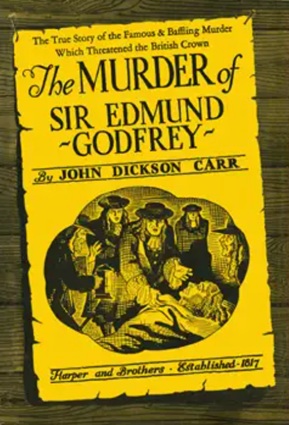
It’s a matter of debate which book is the first historical mystery. Well, it should be, as most people seem to think it’s Death Comes As The End. There are two better suggestions – The Julius Caesar Murder Case by Wallace Irwin (1935), often dismissed due to its modern satirical tone and The Murder Of Edmund Godfrey by John Dickson Carr. There’s a question about whether or not this is a mystery novel too, and I’m not entirely sure even the author knew.
This is a retelling of events leading up to and following the murder of Godfrey and I recommend you bring a notebook as there are a lot of people involved that you’ll need to make notes about. These sections have a slightly odd tone, as some of it is presented as factual, presumably sourced from court records – there are a lot of footnotes, so it’s fair to say Carr researched this well – and other sections where Carr is trying to get into the heads of characters who certainly wouldn’t have written their thoughts down, such as King Charles II. I’ll be honest, these sections are a bit of a slog to get through.
What redeems it to an extent – and it is only to an extent – is the beginning, middle and end sections “For Connoisseurs In Murder” where Carr speaks to the detective novel reader who wants to treat his narrative as a mystery to be solved. There’s no detection in the book outside of these sections, but the middle one is the most interesting as Carr lists twelve theories as to what happened. In the final section, he goes through these theories and dismisses them or argues for them one by one, until he plumps for what he believes happened. And it does kind of come out of nowhere…
One curiosity here is that in these sections, Carr is talking directly to the reader in presumably his own voice and “hearing” the great crime writer speak is fascinating. He is clearly passionate about the mystery of Godfrey and following his own deductions are genuinely interesting, although as I said, you’ll need to have been taking notes to follow every detail.

At the end of the day, this fails as there’s simply too many characters to follow and the main narrative just seems to coalesce into one long description of events. It’s a curiosity to hear Carr speak (sort of) but I can see why reprints of this book are rare.
Oh, if you have a first edition though (smug face) there are some interesting playing cards, of all things, depicting the events reproduced in the centre of the book.
The case of Sir Edmund Godfrey has a lot of interesting aspects to it, but it’s hard to follow. What it needs is a modern author to take a run at it and maybe incorporate it into his long-running series set in the Restoration. You never know, it might happen…
 In Search of the Classic Mystery Novel
If you’re planning to judge me against John Dickson Carr, I await the sequel to this post with trepidation! In the meantime, I agree that The Murder of Sir Edmund Godfrey is more imaginative true crime than detective fiction, though JDC does his best to fit the story into a mystery framework. Just out of interest, in terms of the first historical mystery, where do you place Carr’s Devil Kinsmere (1934), which I confess I’ve never read and which sounds like an adventure story rather than crime, but which is undoubtedly historical and pre-dates the Godfrey book?
LikeLike
I think you are being harsh on what was, for the time, quite a daring experiment – one that perhaps only the author of The Burning Court, would have even tried. That it shifts authorial point of view and has a long list of characters is hardly the most egregious of anomalies in the GAD, surely … Surely Carr’s whole point is fudge the lines between a historical record and a creative interpretation. I think that’s pretty impressive actually 😁
LikeLike
I’m impressed by what he did, just wasn’t enraptured with the end result. You’re right, it’s a grand experiment, and one that should be better known about, but it’s not the most gripping of narratives
LikeLike