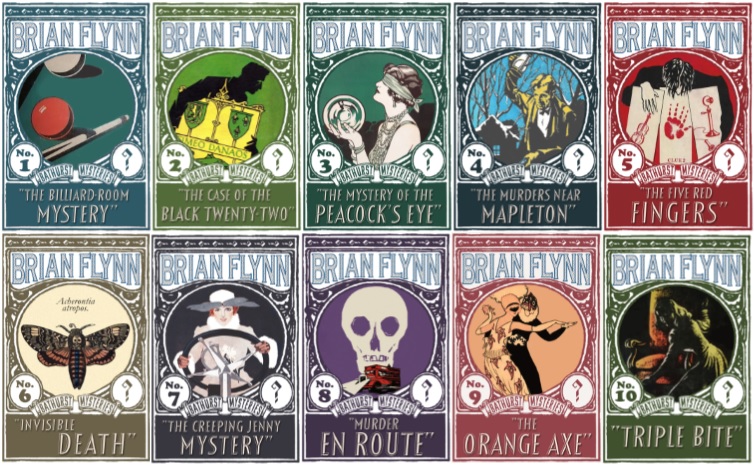

Not a review today – well, not a new one – but it’s been brought to my attention that a book by an author who I’ve spent some time considering for the role of the next Brian Flynn was recently re-released by Galileo Press. And by brought to my attention, I mean they very kindly sent me a review copy.
Wills is an interesting writer – his books go for astronomical amounts and I’ve been lucky to find a few cheap copies of a few of them. Midsummer Murder was the first, and the reason I turn my eye to the writer. Other books of his that I’ve enjoyed are Death On The Line and The Dead Voice but I’d have trouble recommending The Case Of The Empty Beehive though…
Anyway, I thought I’d reprint my review of Midsummer Murder – enjoy!
The cathedral city of Storminster is being plagued by a campaign of poison-pen letters, all typed on the same typewriter, all “signed” with a picture of the scales of justice. Some of the secrets that detailed in the letters are uncomfortably close to the truth – old scandals and crimes are threatened to be revealed, leading the Reverend Selwyn Sneddicombe to investigate, determined to find the writer to protect his parishioners. But his efforts soon become more serious when deaths occur – first of all, an apparent suicide, but the second incident is a clear case of murder.
The police soon have a suspect – Rodney Ashburn’s marriage to Rosalind was apparently in trouble and suspecting an affair with reporter John Archer, he shot Archer dead. An open and shut case – Rodney was witnessed at the scene of the crime. As the jury considers its verdict, Selwyn is determined to find the truth about the dark clouds gathering over Storminster.
There is a little bit of a buzz around the Golden Age readers at the moment about Clifford Witting, so, just to be contrary, I thought I’d look at an author who wrote a book (this one) that has the same title as one of his, and is just about as hard to collect. Cecil M Wills is an author new to me, and was recommended to me a while ago by Martin Edwards. He wrote twenty-six mystery novels between 1934 and 1961, with two series sleuths. This is one of his later books, and is a non-series novel – there is a police investigation, led by Detective Superintendent Fuller, but Selwyn is the the lead sleuth here. To quote gadetection.com on Wills, his books are “pedestrian two-man investigations in the tradition of George Bellairs”. Now one should never judge an author based on a single book (as we all know from Barzun & Taylor’s evisceration of Brian Flynn), but based on this book, that brief summary is quite, quite wrong.
Poison-pen mysteries are difficult stories to tell, because unless the writer is using the “writing the letters to hide the motive for an intended murder” plot, it can be hard to tie the plot strand to a whodunit-murder plot, as the two crimes are quite distinct things. All the way through this book, I was pondering whether the plot would make sense. Was there a good reason for the person to be writing the letters? Was there a reason why the letter writer would know the secrets? Was there a good reason that this would tie in to the deaths – whether it was the writer who was the killer or someone else?
I was delighted to find at the end of the tale that Wills dealt with these questions extremely well. The motivations all round seem believable, if you factor in one character being a bit on the loopy side, but you get a sense in the final scenes of a plan that has somewhat spiralled out of control. Some of the risks taken by the killer seem, well, risky, so it’s no great surprise that they end up getting caught.
It’s not completely perfect as a mystery, notable the overuse of a basic plot device that annoys me a bit, and while there is a sweet romance subplot in the final third of the book, it does come a bit out of nowhere, especially as it suddenly seemed to me that one of the protagonists was significantly younger than I’d assumed – I’ve flicked back and all I see is a few descriptions of him being “bright-eyed”. Oh, and an utterly minor niggle – Storminster seems to be very small for a city, given that everyone seems to know everyone else.
Worth pointing out as well that Wells wrong-footed me completely on the identity of the murderer. It’s often a case with a new author that you don’t know how clever they’re being, but I happily gobbled up the misdirection without realising that I was being misdirected. So that made me very happy to be nicely tricked – I prefer that to working out who the killer is, to be honest.
There’s very little written on Wills on the internet and he’s a swine to collect. In the UK, there are a couple of copies of this one and one other that go for around £20 and then the prices increase significantly. Am I convinced to invest more in Wills based on this one? Well, that is an interesting question – I don’t think so, as those prices are a little steep for me for speculation, despite this being a very enjoyable and engrossing read. One mention on the internet is that he gets better as he writes more, so this might well be one of his better works. I’ve one more on the TBR pile that I will read soon but not sure my wallet will support a serious investigation into the author. I will certainly keep an eye out though…
And present-day me is back. It’s a bit odd that I mentioned Witting in the review as he is another author who Galileo reprint, and you can expect a review of Silence After Dinner very soon – because they sent me that too! In the meantime, do take a look at this one. It’s probably the best Wills that I’ve read so a good judge of whether you’ll like the writer or not.
 In Search of the Classic Mystery Novel
It is a mark of the esteem in which I hold your work that I’m going to give this one a go despite the review you quoted comparing Mills to Bellairs. I tried one Bellairs (Death on the Last Train) and DNF’d it, so if this one has a similar outcome, I’ll have to go all Liam Neeson on you for a refund. 😁
LikeLiked by 1 person
I read this one a few weeks ago. I rather enjoyed it but, unlike Witting’s Midsummer Murder, which I reread recently and is very emphatically set in summer, there’s no real sense of why it’s called that. It’s got a very time-reliant mechanism but the times left me a bit baffled. I also found the courtroom scenes a bit dull because they’re there to serve one purpose alone, which is – treading warily for fear of spoilers – to bring a character before us, but he spends a long time simply recapitulating the plot to this point. The Trollopian setting is nicely done, though.
LikeLiked by 1 person