 And so, after A Scandal in Belgravia and The Hounds of Baskerville, the final episode of series two of Sherlock draws to a close… and how on earth do I review that without spoiling it for the uninitiated? I can’t even mention the opening scene!
Obviously The Reichenbach Fall is based on the short story The Final Problem, the first and last meeting (on paper) between Holmes and Moriarty. (He also appears in the written-later-but-set-earlier The Valley of Fear, but he doesn’t meet Holmes). I figure that story is reasonably fair play to spoil, so if you haven’t even read that, look away now.
Still here? Good.
OK, as we all know, in The Final Problem, Holmes has succeeded in arranging for the capture of Professor James Moriarty’s gang and goes on a quick hideaway to Switzerland. Moriarty follows him and, after luring Watson away, has a bit of a fight with Holmes and they go over the edge of the cliff at the top of the Reichenbach Falls. All this while wearing a top hat and opera cloak, if you’ve seen the Jeremy Brett version. I’ve reviewed the short story here, so you can read my issues with it if you like.
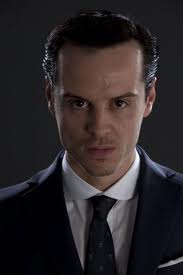
If you’ve watched Sherlock so far, you know that Jim Moriarty, criminal mastermind extraordinaire, has been lurking in the background for a while. Well, he explodes into the foreground by breaking into the Tower of London, the Bank of England and Pentonville Prison simultaneously. It seems he has a key that can open any door… but what is the nature of that key exactly? Moriarty is arrested and on trial in the Old Bailey, but his defence refuses to give any case at all. Surely this is the end of everyone’s favourite nutjob of a criminal? Meanwhile, Sherlock is becoming more and more famous – he is now famed for recovering a painting by Turner of The Reichenbach Falls. But when you’re on a pedestal, it’s very easy to fall off…
Right, that’s about five minutes out of the ninety summarised, and if you want more, go and find a more spoilery review. This does follow at times the structure of The Final Problem – there are similarities and differences but even if you think you know where it is going, there are still surprises in store.
Highpoint include:
- Moriarty’s arrest
- Holmes and Molly
- John and Mycroft
- The updated version of the Holmes and Moriarty conversation in Baker Street
- Moriarty’s bedtime story
- Kitty Reilly’s source
- Molly again
- The rooftop
- The updated version of the note
- The reason for the Fall – in more ways than one
And so much more…
But… I’m going to be careful how I word this. When a magician performs a trick, you don’t expect an explanation. When a detective solves a crime, you expect one. By the nature of the conclusion, that explanation will be at least a year in arriving and will belong in a different story. Not the obvious “How” explanation, that’s a part of the equivalent of The Empty House, but the “How Did He Know?” part. It looks for a while at the end that Jim has completely bamboozled Sherlock, but from the final section, we know he didn’t. It would have been nice to see how much Sherlock had worked out. I have absolutely no idea how that would have fitted in without completely derailing the narrative, but I do hope that is included in the future somehow.
But that’s the minor gripe out of the way. The cast were, as ever, outstanding, not just Cumberbatch and Freeman, but also Rupert Graves as Lestrade, Louise Brearly as Molly and the wonderful Una Stubbs as Mrs Hudson. The writing was first rate – a big step up for Steve Thompson from The Blind Barber in series one. I do hope that we don’t have to wait too long for the next series – and there is one, in case you didn’t know. That sneaky Moffat and Gatiss have known since series two was commissioned that there would be a series three – they just didn’t mention it.
So, the best thing on television for ages? Without a shadow of a doubt… Just a shame that a certain character won’t be in the next series…
 In Search of the Classic Mystery Novel
I really loved this too – it’s hard to imagine a die-hard mystery fan that didn’t frankly.
I had the thoroughly amusing experience of providing a rationale for the events of the concluding ‘fall’ twice in less than 12 hours – first to my mother yesterday evening just after the screening when she just got totally confused by the final shot -and then to my work colleague in the morning who somehow managed to not notice to return of a prominent character in the last shot of the episode (!). What I like most about the finale is that it gets everyone talking and coming up with their own theories (as fans of JONATHAN CREEK, I don’t imagine you’ll be particularly confused or worried – I certainly wasn’t) – which is a brilliant updating of the reaction to the original publication of “The Final Problem”.
More than anything that marks the genuine success of this adaptation – it got people excited about Sherlock Holmes again and still managed to add a bit of mystery (or even a lot) to a characters who has been already played literally hundreds of times of screen. Not only is that no mean feet, it is near-miraculous. Gatiss and Moffat deserves huge amount of praise,as does the truly excellent cast – and Moriarty, who I originally had mi doubts about, was but the end just perfect for this interpretation as the ‘consulting criminal’.
Definitely 11 out of 10 from me!
Sergio
LikeLike
I recently rewatched the last episode of series 1, and Moriarty had me laughing hysterically all the way. I really don’t understand why my thespian friends (I used to be involved in theatre) are so enamoured of the performance. It was so extremely silly… nothing at all like what Moriarty should be. They just took a really bad joke and streeeeeeeeeeeeeeeeeetched it…
LikeLike
I think I’m in the minority in the fact that I enjoyed Moriarty’s first appearance – as with the rest of the series, it played with expectations and gave a Moriarty that I figured could get one over on Sherlock due to his unpredictablity.
Trust me when I say, when you see The Reichenbach Fall, you will be won over. I don’t think I’ve seen a negative comment about Andrew Scott in this one. It just works perfectly.
LikeLike
You were entirely right. I saw the new series (let’s just say I have my methods) and finally in the last episode I was won over. He finally manages to seem like a credible threat!
LikeLike
Honestly I had no idea what was going on at the end. Not the very last scene, which I think it has something to do with when Sherlock said “I want you” to Molly, but mostly about what happened at the rooftop. What did Sherlock mean that if Moriarty was alive then he wouldn’t need to jump?? Why did Moriarty have to pull the trigger?? What kind of significance does ” I O U” have?? I feel like I am missing out a lot here because I just don’t understand, and I don’t think these are questions that will carry on to the next season. It will be so kind if anyone figures them out can give me a little insights.
As about Sherlock, I can’t help but to think how could he fall into such obvious traps? Why would Moriarty hint him about this “key code” which supposedly can open up all doors or even used to be against himself? It just doesn’t make sense for Sherlock to believe that. Of course, as a Sherlock Holmes, or detective stories fan in general, no matter what happens, you always want to believe the detective actually have it all work out at the end. So I am hoping to have everything answered in the future.
Despite all my questions, I really enjoy the stories and the cast, including the wonderful Molly and Mrs.Hudson. Not to mention I was sobbing at the end. It is surely worthy to wait almost 2 years just for that 3 episodes, although I still hope if there is indeed a season 3 there will be more than just 3 episodes.
LikeLike
Well, I can’t answer your questions due to a) the nature of the blog and b) it would be speculation but I think for Sherlock to have done what he did, he must have worked it all out – the “how” of that is the explanation that I fear might be missing from the next series. I think I can forgive Gatiss & Moffatt if they do though…
LikeLike
I know what you mean about losing Moriarty, but I think the series has to move on or else the show becomes more about the Sherlock-Moriarty dynamic than it does the Sherlock-John one. Moriarty was never meant to be more than an invisible hand in the background to challenge Sherlock – once they have actually confronted each other someone has to win and someone has to lose. I really hope they don’t bring Moriarty back via some contrivance. Sometimes it’s best not to gild the lily.
LikeLike
Oh, quite right. I was pleased to see that Moriarty only made one proper appearance this series – it does bug me that Holmes’ so-called archnemesis only appears in two stories – and one of them retroactive as even Conan Doyle realised that such a villain needed more that Holmes telling us how evil he is.
I’m curious as to the tales that will be used as the basis for the third series. Let’s face it, The Empty House is rather bland as an inspiration…
LikeLike
True. I’m imagining we might see The Empty House dealt with rather quickly (if at all), and then launching into a completely different story.
LikeLike
[…] moment, most notably in the BBC1 series Sherlock – see my reviews of Episode 1, Episode 2 and Episode 3, but also in the high quality audio dramas from Big […]
LikeLike
[…] all… allegedly – we’ll come to that in a bit. It’s recently had a major updating as The Reichenbach Fall, the series 2 finale for Sherlock, but what about the original […]
LikeLike
Wow, you showed remarkable tact and restraint, PD–all the other ‘Reichenbach Fall’ reviews I’ve read contained spoilers. I’ll attempt to show the same discipline you did with my comments here. 🙂
I thought this was easily the most memorable ‘Sherlock’ story to date. The previous episodes had terrific acting, dialogue, and puzzles, but the series 2 finale managed to pack an enormous emotional punch, one that left a truly deep impression. I would be very surprised if anything else on television this year will come close to the heights reached by ‘Reichenbach’.
Also, I wholly share your enthusiasm for both Andrew Scott and his portrayal of Moriarity. Conan Doyle’s version of the character was a caricature. As another reviewer suggested, Conan Doyle’s creation was more of a plot device, an invention necessitated by the author’s desire to have Holmes meet his end in ‘The Final Problem’.
The Moriarity in ‘Sherlock’ is a fully realized psychopathic genius whose remarkable abilities are shown on camera. Scott’s Moriarity is scary, unpredictable, and completely convincing as a match for Holmes’s formidable powers. I just can’t say enough about this excellent character and how he shone so brilliantly in this conclusion to series 2.
I am already experiencing ‘Sherlock’ withdrawal….
Cheers!
Anthony
LikeLike
Well, as you say, it was such a memorable piece of television. I’ve been on the receiving end of accidental spoilers for crucial TV shows in the past – notably The Guardian ran a “Buffy dies at the end of the series” headline at least two months before the relevant episode. Given how far ahead in terms of quality Sherlock is of that programme… I’d hate to be the one to spoil it.
At some point – probably a week before series three, whenever that may be, I’ll give my theory as to what happened, but until then, let the mystery remain…
Oh, and if you think Doyle’s Moriarty was a caricature – which I didn’t think from the story myself, but he is lacking in motivation – have you seen Eric Porter in the Jeremy Brett series? All he’s missing is a moustache to twirl…
LikeLike
Yes, I am familiar with Porter’s Moriarity in the Grenada series. (My wife is an enormous fan of Jeremy Brett’s Holmes and thinks any attempt to modernise Conan Doyle’s stories is sacrilege. She has no idea what she’s missing!) Porter’s portrayal of the villain pretty much embodies the issues I have with how Conan Doyle handled the character: he’s alleged to possess an intellect that rivals (if not equal to) Holmes’s. Yet Moriarity simply shows up to snarl at Holmes and later tries to exact vengeance by engaging the detective in fisticuffs.
I think the writers (I have to believe Messrs Moffat and Gatiss worked extensively with Steve Thompson on the script for the finale) recognised the shortcomings of Conan Doyle’s villain and did an absolutely cracking job of reinventing and vastly improving the character. I am most curious to see if the creative team will attempt to flesh out Colonel Sebastian Moran (or some version of that character) in a similar fashion.
LikeLike
[…] Oh, and Sherlock will be back, too, but everyone knows that. My Sherlock reviews are here, here and here. […]
LikeLike
[…] of Sherlock were almost universally applauded – but with such a cliffhanger at the end of The Reichenbach Fall, could the writing team possibly come up with a satisfying […]
LikeLike