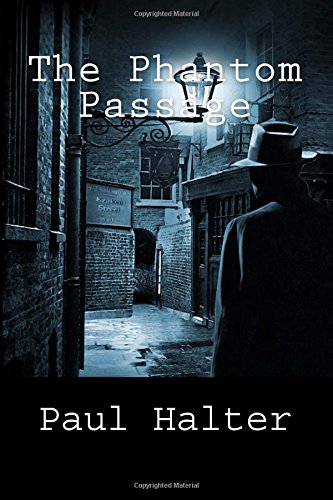
 Owen Burns and his friend Achilles Stock are having a late night drink in Burns’ rooms. He is taking the opportunity to rue that nothing interesting is happening at the moment, the sure sign that the detective is about to embark on one of his most interesting cases. Sure enough, Ralph Tierney, an old school friend, arrives with a bizarre tale.
He lost his way in the fog and was lured into Kraken Street, not much more than a narrow alley, by a strange individual. He is then directed, by two more individuals, into a house where he sees a most peculiar vision. He flees from the house and the street itself, but, on regaining his senses, returns to the area only to find that Kraken Street has seemingly vanished completely.
Other people have also visited this house in this non-existent street – the visions seems to be either of the past or the future. But when the visions start to come true, it seems that there is a hand directing these bizarre events – or possibly the street truly is a Phantom Passage…
Well, of course it isn’t. Not that sort of book. It’s the sort of book that embraces the Grand Guignol aspects of some of Carr’s writing, notably The Hollow Man, and the reader needs to embrace that as well before reading it. Because if you do, you’re in for a treat. If you don’t, then it has plot holes (notably in the motivation side of it) that you could drive a bus through. I’d suggest just relaxing and enjoying it.
This is the tenth of Paul Halter’s novels that have been translated by Locked Room International and the third of those to feature Owen Burns (although actually the fourth written by Halter and even though, it seems from the comments in the book that it’s set after The Lord Of Misrule). Halter embraces the locked room/impossible crime genre with both arms, constantly looking for a new situation or solution rather than rehashing the basics. This can lead – in fact, it often does – to a set-up that is over the top, but which, when on form, can make a cracking read. I think this is one of those cases.
As it’s a relatively short book, the less said, the better, but the central mystery is really well done, twisting and turning all over the place. The clueing is odd – the part where Owen reveals how he worked things out is nothing more than listing some coincidences which, given some of the other accepted coincidences in the book, really aren’t clues at all. And the motive for one aspect – and I checked this with the translator – isn’t spelled out at all and the most likely answer is pretty weak for a major crime. Add in the fact that there are much easier ways to achieve the desired goal…
But if you can put this all to one side, it’s a clever trick and a highly enjoyable read. Highly Recommended – just don’t think about it too much after finishing it…
 In Search of the Classic Mystery Novel
Thanks for reviewing the latest translation, hot off the press! I’ve just ordered ‘Demon of Dartmoor’, and am tempted to add this to my list of purchases.
Could I ask for an opinion on a broader scale: what would your top 3-5 Halter titles be, and where would this stand in relation to the very best of Halter’s works? I’ve so far read three of his works, but felt that only ‘Seventh Hypothesis’ – the other two being ‘Crimson Fog’ and ‘Seven Wonders’ – made the cut for great, as opposed to just good, reading.
LikeLike
The best is definitely The Demon of Dartmoor. The Fourth Door and The Picture From The Past are clever and The Invisible Circle is good as well, although this one is better. The short story collection, The Night Of The Wolf, is good as well, although I haven’t reviewed that yet. If you wait ten minutes, then I’ll have a bibliography ready (under the Bibliography tab at the top) for the reviews.
LikeLike
I’m surprised that ‘Seventh Hypothesis’ hasn’t made it into your top 5! Thanks for the recommendations. Looks like I should get ‘Picture’ too. 🙂
LikeLike
Oh, didn’t mention that one as you’d read it. Definitely include that one. The weakest ones are The Lord Of Misrule and The Tiger’s Head imho.
LikeLike
With all due respect to the Puzzle Doctor, I think Lord of Misrule is underrated and is much better than The Invisible Circle.
This book really impressed me. I was able to figure out how the Kraken Street disappearance was done, and I strongly suspected (but wasn’t 100% sure) the identity of the killer. But there was one last twist Halter added at the end that completely threw me for a loop.
One more thing. I usually beg to differ when somebody says that Pugmire’s translations are so good you usually don’t know they’re translations. There’s been bits here or there where I do notice the difference. Except for one place where he uses “souvenir” in the French sense of “memory” rather than the English sense of “object evoking memory”, I would have thought this book was originally written in English.
Owen Burns may not be the Paul Halter’s “go-to” detective (I think he has written more stories with Dr. Twist) but this is the book that firmly establishes Burns as Halter’s Sherlock Holmes.
LikeLike
Yes, I suspected the same person.
LikeLike
“And the motive for one aspect – and I checked this with the translator – isn’t spelled out at all..”
Can you give a hint what you are referring to ?
LikeLike
Not without spoiling things – if you didn’t have an issue with it, you’ve put two and two together and worked it out, weak as it may be.
LikeLike
I have now realised what you were referring to. Yes, the motive can be guessed but it is weak.
LikeLike
By the way, did you notice the discrepancy between chapter 5, para3 and chapter 15, last para regarding a body ?
LikeLike
This looks tremendous. I quite enjoyed Crimson Fog a while back and have just ordered Invisible Circle.
LikeLike
Definitely preferred this to The Crimson Fog. Hope you enjoy the Invisible Circle
LikeLike
My review is at https://www.goodreads.com/review/show/1340844884
LikeLike
Interesting plot. I’ll have to look this one up. I don’t get by your post often, but when I’m in the mood for a good mystery, I stop by and browse. Love doing that. It’s like a bookstore.
LikeLike
Though Halter may not match Carr in atmosphere creation and characterisation, Halter is unsurpassed in imagination. Halter’s impossible situations are much more varied than Carr’s.
LikeLike
But often lacking in logic, especially in motivation. Here we have a seemingly sane protagonist with an utterly insane plan for no good reason at all. The “why do it” is an important part of the locked room mystery, and it’s one that Halter sometimes ignores – although I’m sure a Carr example can be found as well…
LikeLike
The motive in this case is explained in the para starting,”Since the disappearance of….” on the first page of chapter 27(Epilogue) and the subsequent 2 paragraphs.
Also note the para beginning,”It wouldn’t be the first time a criminal used such a method…” in chapter 24.
LikeLike
Oh, it’s explained – doesn’t mean there are (much) easier ways to achieve the same goal that are a) more reliable and b) doesn’t involve killing people. Still a fun book though
LikeLike
I agree that the killing was totally unnecessary and stupid. It would have been more sensible to show a past event in that case also.
LikeLike
[…] The Phantom Passage by Paul Halter […]
LikeLike
[…] gel, although I am in the minority here. But when it works, like in The Invisible Circle, The Phantom Passage and, in particular, The Seventh Hypothesis, which in itself is a very different tale than you might […]
LikeLike