 The actress Jane Wilkinson, aka Lady Edgware, is determined to arrange a divorce from her husband, to the extent that she asks her new acquaintance Hercule Poirot to speak to him for her. He does so, as a study in human nature, but is surprised to find that Lord Edgware has no objection to the divorce at all. So it is all the more surprising when he is found the next morning in his study, stabbed in the back of the head.
Even more surprising is the news that Jane Wilkinson committed the deed. She was witnessed entering the house at the time of the crime – despite being in the middle of a dinner party miles away at exactly the same time. When an entertainer who makes her name impersonating the rich and famous – including Jane Wilkinson – it seems that someone has gone to extraordinary lengths not only to kill Lord Edgware but to ensure that Lady Edgware pays for the crime as well…
Another book for Crimes Of The Century 1933 for Past Offences and I seriously doubt that I won’t be the only person to be reviewing this one. And, as you might guess, it’s a re-read for me – I first read this one at least thirty years ago. According to Goodreads, this is the median of Poirot books – 15th out of 29 – but I have very fond memories for it. Not sure that’s a good thing… but more on that later.
First off, what does this book tell us about 1933? Well, we’ve got that good old casual racism, as Poirot fears that a Jewish character will be in danger due to her love of money – at this point, Poirot knows nothing about her apart from her race. We’ve got the fact that Dame Agatha seems to think that “anyrate” is a word – she uses the phrase “at anyrate” at least four times in the book. We learn that in June 1933, “the hat of the moment was shaped like an inverted soup plate and was worn attached (as if by suction) over one ear, leaving the other side of the face and the hair open to inspection.” And being a “kinky sort of person” definitely doesn’t mean the same thing. See, who said you can’t learn things from blogs.
The mystery… Right, obviously I’m not going to spoil it, but if you’re smarter than the average bear, I think you might put two and two together. So you might want to skip the bit in italics below. In the meantime, it’s a good early Poirot although not the best. Pretty median, to be honest. Well Worth A Look.
OK, the mystery… it’s well clued and everything is there to work out what’s going on – but it’s pretty obvious, isn’t it? I solved it when I first read it when I was fourteen-ish and, unlike when I read Peril At End House, didn’t feel as if I was being clever – just that Poirot was being exceptionally stupid. He takes an age to spot the bleedin’ obvious – the purpose of the mysterious phone-call shouldn’t take him all book to work out and if you spot it, it gives the whole game away. You also find yourself looking for what the clever Christie trick and given that it doesn’t really appear in the set-up, there’s only one way it can appear in the solution. Genuinely curious here – was anyone fooled by it?
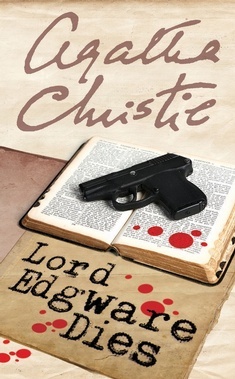
Oh, and what’s that gun doing on the cover?


I was fooled by it the first time I read it long ago. I’ve always thought since that it has a clever structure, which I won’t go into for fear of spoiling it for someone. I bow to your superior solving skills. I am not worthy!
LikeLike
The thing is, I don’t feel that I solved it – I just thought “Surely it’s just…” And it was. A bit like Peril At End House, but that’s got a more complex plot.
LikeLike
In other words, “elementary, my dear J. J. McC.”!
LikeLiked by 1 person
Can’t remember how easy I found it to solve but to be honest I don’t really have any clear memories surrounding the book which probably goes to show that it probably wasn’t one of Christie’s most remarkable or memorable books. Brad at ahsweetmystery blog has also reviewed the book for Past Offence’s challenge:
https://ahsweetmysteryblog.wordpress.com/2016/02/08/poirot-on-the-trail-lord-edgware-dies-1933/
LikeLike
” I seriously doubt that I won’t be the only person to be reviewing this one. ”
Well, 2 negatives make a positive !
“So you might want to skip the bit in italics below. ”
I don’t see any bit in italics !
LikeLike
I’d be cross about the pedantry here if I hadn’t picked on Dame Agatha for her spelling in the post. But I’ve added the italics now.
LikeLike
“…she uses the phrase “at anyrate” at least four times in the book.”
She actually uses it 10 times. However, it has been corrected in current editions, the words any and rate being separated.
LikeLike
How do you know the exact number? Do tell.
LikeLike
Well, I counted them !
LikeLike
Seriously? You speedread the whole book just to count them? Impressive.
LikeLike
While speedreading, I detected another mistake. The French expression Cela ce peut in Chapter 22. The second word is spelt incorrectly. It should be Cela se peut meaning “That may be”
LikeLike
In older editions, there are 2 offensive words in chapter 2: C***ks and n***er.
However, these have been removed from current editions. The word C***ks has been replaced by Chinese. The entire sentence containing n***er as well as the beginning of the next sentence have been removed and in place of these two sentences, the text now simply reads, ‘ Presently he made several remarks of a hopeful character.’
(JJ may be displeased at this !)
LikeLike
C***s? In an Agatha Christie novel? Good grief!
LikeLiked by 1 person
The word is spoken by a character.
LikeLike
I must have an interim edition – I didn’t spot those phrases, but, as I said, the Jewish slur was still there. My edition isn’t the one pictured but my scanner isn’t working at the moment and couldn’t find the right cover online. It’s the Fontana one with the back of the head with the spike in it (which isn’t the murder weapon either!)
LikeLike
I quote from chapter 2 of the edition available with me:
‘You don’t say so. Now I could have sworn you were a chap called Spencer Jones. Dear old Spencer Jones. Met him at the Eton and Harrow and borrowed a fiver from him. What I say is one face is very like another face—that’s what I say. If we were a lot of Chinks we wouldn’t know each other apart.’
He shook his head sadly, then cheered up suddenly and drank off some more champagne.
‘Anyway,’ he said. ‘I’m not a damned nigger.’
This reflection seemed to cause him such elation that he presently made several remarks of a hopeful character.
LikeLike
Just checked and that is in my version (1978). No idea how I missed that! Must have turned over two pages at once – can’t believe that was still unchanged so late, but then again, my copy of Ten Little N#####s with the hanged golliwog on the cover is from the same time…
LikeLike
I don’t see anything wrong with those words if they’re spoken by a character, and I think the publisher shouldn’t censor them. It reveals the character of the speaker effectively in a few lines. Removing them would be comparable to taking the n-words out of Huck Finn.
LikeLike
Yup, furious! 🙂
LikeLike
“Well, we’ve got that good old casual racism, as Poirot fears that a Jewish character will be in danger due to her love of money – at this point, Poirot knows nothing about her apart from her race”
All such negative references to Jews have been removed from current editions !
LikeLike
A decent read bu not a favourite (I much prefer PERIL AT END HOUSE)
LikeLiked by 1 person
Reading the comments, I’m inclined to think this is less complex than I remember. Because I remember it being very complex. However, End House really is an absoute corker.
LikeLiked by 1 person
But also very obvious…
LikeLike
I know what you mean – if I was reading it for the first time now I like to think I’d figure it out, but as it was about only the the fifth or sixth Christie I read (and so the fifth or sixth cassic GAD novel I read) it ran me in all sorts of circles…!
LikeLike
[…] Lord Edgware Dies by Agatha Christie […]
LikeLike
[…] The Puzzle Doctor picked up on some different 1933 aspects in his review of Lord Edgware: […]
LikeLike
[…] Edgware Dies has been reviewed at Reviewing the evidence, Mysteries in Paradise, In Search of the Classic Mystery Novel, Christie in a Year – Extended, ahsweetmysteryblog, and Bitter Tea and Mystery among […]
LikeLike
[…] Lord Edgware Dies […]
LikeLike
[…] Edgware Dies has been reviewed at Reviewing the evidence, Mysteries in Paradise, In Search of the Classic Mystery Novel, Christie in a Year – Extended, ahsweetmysteryblog, and Bitter Tea and Mystery among […]
LikeLike
[…] Table. Readers who prefer entertaining but solvable problems should look to Peril At End House or Lord Edgware Dies. If you’d prefer a cunning mystery and can turn a blind eye to some horrendous sexual politics, […]
LikeLike
[…] In Search of the Classic Mystery […]
LikeLike