“I’ll sing you six, O; Green grow the rushes, O
What are your six, O?
Six for the six proud walkers; Five for the symbols at your door;
Four for the Gospel makers; Three, three, the rivals;
Two, two, the lily-white boys, Clothed all in green, O
One is one and all alone; And evermore shall be so.”
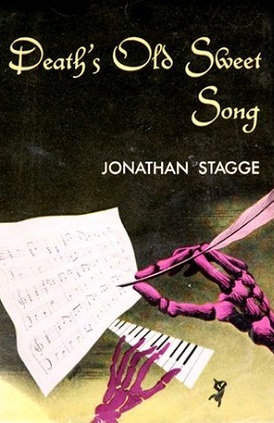
Dr Hugh Westlake is vacationing in Skipton, a town not too far from where he actually lives – does he know what a holiday is? – and has formed a close bond with Ernesta Gray’s family. Ernesta is the matriarch not only of her family but also the whole neighbourhood, so it’s probably a good thing that an apparent maniac chooses the weekend when she is away in New York to go on a folk-song inspired rampage.
First it was the young twins, Billy and Bobby, their green-clad bodies found floating in the duck pond. And soon the death-count starts climbing higher and higher…
This is the eighth book out of nine written by the conglomerate who were also behind the Patrick Quentin and Q Patrick titles, all featuring Dr Westlake. Moving him to a neighbouring town means that there are no recurring local characters beside Westlake, his daughter and the local constabulary – it is weird that Westlake is holidaying somewhere where he is still the local coroner – so when the serial killer starts on his/her rampage, all bets are off as to who is going to die.
That’s especially true given the complete inability of our heroes to protect anyone despite the folk song predicting in some cases exactly who the victim will be – the Gospel makers is obviously the local priest, but do they do anything? Nope. There’s not exactly much detection going on here, as everyone basically sits around waiting for the murderer to get to six before actually making any deductions. One has to ask why everyone seems to know that the killer is going to count to six when the song goes all the way to twelve in the final verse – it’s a bit like Twelve Days Of Christmas.
Having said that, there’s a really clever false solution that had me suckered. By the halfway point, I was certain who was behind everything and that was exactly (I presume) what the writers intended. It’s one of the best red herrings I’ve seen for a while. Having said that, it’s a lot more interesting that the identity of the killer and the motive which is rather weak for such a bloodbath. Indeed, the killer seems only to be identified when they realise that someone else needs to die and basically messes things up.
All in all though, I did enjoy this one, although it could have done with fleshing out the cast a tad more – a few get some development, but others remain fairly two- or even one-dimensional. There are plot holes you could drive a bus through, but it’s entertaining, nonetheless.
 In Search of the Classic Mystery Novel
I read several Stagge novels in my youth and really liked the darkness of them and the clever plotting. Wheeler brought a lot of depth to the characterisation when he joined in ’36 , especially in the Duluth series. However, Webb was apparently the main partner on the Stagge series apparently. But this doesn’t ring a bell, so may have skipped this one (though I reckon there is a copy on my shelves somewhere). Or it’s just been too long …
LikeLike
I read this earlier in the year and had a very fun time with it. I too fell for the false solution you mentioned; it really is well played. The real solution is definitely a bit deflating afterwards, although I felt the clue that leads Westlake to the motive (and thus the murderer) was rather brilliant. Was annoying how bad the characters were at stopping the murders for sure.
LikeLike
Like this one a lot! Plausibility be damned! The setting is quite authentic.
LikeLike
I’ve read three Stagge novels so far and this is by far the best of them. That’s not an endorsement of Death’s Old Sweet Song – it’s definitely lacking – but it stands out much better than the other two that I read years after it.
LikeLike