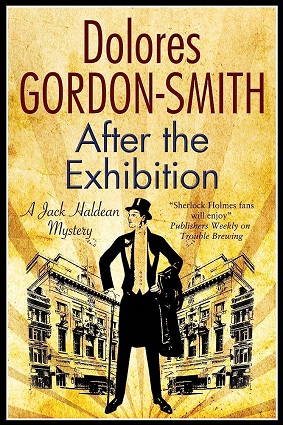
When Chief Inspector Bill Rackham invited his friend, writer-cum-sleuth Jack Haldean, to the Lythwell & Askern exhibition of church art, he wasn’t anticipating a particularly exciting outing. And indeed it wasn’t, apart from the flag-seller, that is. As Haldean was leaving, along with the various members of Lythwell and Askern families, she focussed on the group, muttered “Art” a few times and collapsed. Once it was deigned that the woman would be all right, Haldean thought nothing more of it.
Until Betty Wingate, the ward of the Lythwells, came to him with a story about a dead body. A dead body in someone else’s house that promptly disappeared without a trace. As Jack begins to believe Betty’s story, he begins a hunt for a murderer – which can be a problem when you don’t know who the victim was…
OK, this review has been pending, but I’ve been rather under the weather for the past few days. Haven’t even read anything since Tuesday, so it must have been bad. Anyway, things are abating, I think, and I’ve got the attention span to write this review. Of a book that I read over a week ago and is somewhat hazy due to two days ingesting a bucket load of painkillers… Still, it could be worse, I reviewed Nemesis several years ago and I read that when I was smashed out of my head on post-operation painkillers.
I picked this one off my shelf as I knew I was going to be meeting Dolores at Alibis In The Archive and oddly, because her books are on one of my bookshelves that are sort of for display – complete sets of my favourite authors – sometimes I forget that I haven’t read them all. So I grabbed this one, the eighth in a series that I never read in order for some reason.
I’ve said this before, but I think there is no one better at mimicking the Golden Age whodunnit that Dolores. Some writers are determined to do something new within the genre – Martin Edwards for example – and many others, who I won’t name, seem content to use simply setting and stereotypical characters pasted over a cosy plot. Dolores gives the book a depth of plot and character, with a delightful prose style and a multi-layered mystery. Something that I meant to say about Martin Edwards’ Sepulchre Street applies just as much here – every character is in the plot for a reason beyond being simply a red herring. They all have a role to play in the overall mystery plot which makes the solution all the more satisfying.
One niggle – I wasn’t clear if the reader was supposed to be able to work out the solution to the treasure hunt, but having said that, I did like the nature of the treasure – very clever, especially the first reaction to it.
I make it that I’ve got four more Haldean books to read – looking forward to each and every one of them.
 In Search of the Classic Mystery Novel
“…and many others, who I won’t name, seem content to use simply setting and stereotypical characters pasted over a cosy plot.”
This is a perfect description. With one exception, I’ve not had much luck with modern authors trying to imitate the GAD.
LikeLike
Whoop! Thanks ever so much, Steve! I was ridiculously pleased with the treasure hunt as it hinged on a real pub quiz type fact I’d been nursing for years! And I got to write a sonnet about it which is always gratifying. It was really nice to spend time with you at Alibis, even if I did over estimate my knowledge of Victorian crime fiction for the quiz. I hope you feel tons better soon
Xxx
LikeLike