Meet Laurence Vining – a polymath who lends his general amazingness to Scotland Yard when they are stumped on a case. He and his assistant, Dr Ben Willing, have just solved the excitingly dubbed “Shop Murder”, with the villain of the piece heading for the gallows. So what is next for the great detective?
Well, getting murdered, that’s what. The clue is in the title, people…
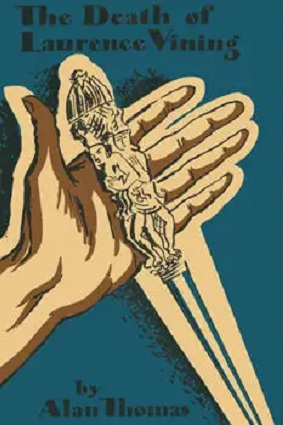
When Vining got into the elevator at the ground level of Hyde Park Corner underground station, he was in perfect health. And alone. But when the doors open at platform level, he’s still alone, but there’s an ornate knife sticking out of his back. But how can that possibly have happened? Time to call in Laurence Vini… oh, hang on…
There are certain books that people clamour to get reprinted – this isn’t one of them, mainly because most people haven’t heard of it. Alan Thomas wrote eight books from 1928 to 1935 – this is the first – and eight more from 1951 to 1970, according to gadetection.pbworks.com, with possibly the last eight not being from the mystery genre. Possibly. His books are so hard to find, nobody seems to know. Any info, gratefully received.
And before the offers come rolling in, I read this on my most recent visit to the Bodleian – I don’t own a copy.
There are a few reviews of the book out there, at least one of which claims to have identified the killer very early on. I think a lot of people will have – I asked myself one question at the beginning and then promptly forgot about it, but if I had pondered it more, I think I’d have solved it too.
Well, by solving it, I don’t mean every little detail, which is spelled out at the end of the book – the map that is provided earlier in the tale is reproduced with annotations – and the villain is even kind enough to include what he would have done if any of the hundred and one things that could have gone wrong did go wrong. Stops people like me moaning about it, I suppose.
Right, where was I? It’s a pretty decent book, especially for a debut. Like another once-obscure author, Thomas tries something structurally clever with his debut and unlike the other author, isn’t gazumped by someone with a better publisher doing the same thing. As I hadn’t twigged as to what was going on, the thumb-twiddling of the middle section didn’t come across as such, and the penultimate section ends with a really effective sting, one of the best I’ve ever read.
However… there’s something about the ending that I just didn’t buy. I’ve seen it elsewhere, in particularly in a John Rhode or two, and in those cases, it seemed to make sense. In this case, especially given the players in the drama (really trying to be vague here) I just don’t think what was not done could not have been done.
Oh, and there’s a bit of generalisation about the entire population of Malaysia – reflective of the time, certainly, but it’s a bit on the iffy side. Although generally, the character of Suleiman, the Malaysian butler, is done pretty well, to be fair, despite the many unacceptable words various characters call him.
All in all, this is definitely a book that could do with being better known, even if a few words need to be asterisked. Next time I go to the Bodleian, I might well look up something else by the author…
 In Search of the Classic Mystery Novel
The premise strikes me as amusing, the stereotypic annoyingly superior GAD amateur sleuth as victim.
LikeLike
The Death of Laurence Vining is not the only mystery from this period, mid-to late 1920s, trying to subvert and experiment with the Watson (narrator) and Holmes (detective) roles. In hindsight, it almost feels like the detective story shaking off the last vestiges of the Doylean era as it’s about to enter its own golden decade.
“Any info, gratefully received ”
I reviewed The Death of Laurence Vining a few years ago and Curt left a comment saying plans were afoot to get all his books reprinted, but that was three years ago.
LikeLike