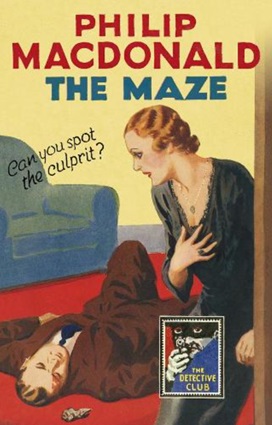
Colonel Anthony Gethryn was on holiday, looking for a bit of piece and quiet. The problem with being known as a successful resolver of murder and mayhem, however, is that sometimes people need you to solve their problems. So when the transcript of the coroner’s report into the unsolved death of Maxwell Brunton, it seems that Gethryn has some additional holiday reading.
Maxwell Brunton was found dead in his study, his head bashed in by a piece of quartz. Ten other people were in the house, most of whom had a very good motive for the murder. But armed with only the coroner’s court transcript, can Gethryn solve the case? And, more importantly, can you?
Insert the usual apologies for the slowness of the blog – work, car problems, health niggles – and let’s take a look at this one.
It’s got a bit of a reputation. The ninth book featuring Anthony Gethryn, it’s claimed to be a perfect logic puzzle, where everything you need to solve it is given to you before Gethryn begins to give his thoughts to the matter. And… well, it’s okay.

There’s nothing particularly wrong with it. The structure’s a nice idea, although the cynic could argue that it’s just a slightly different spin on those books that consist of murder followed by countless interviews followed by the solution. And I got the feeling that at some points Philip Macdonald was indulging himself a tad in writing silly voices – it felt like it was being narrated by Prince Ludwig the Indestructible.
As for the mystery – well, it’s fine except it’s not desperately complex. It almost feels like the plot of a short story that has been lengthened by the format (and the epilogues that really go on a bit). It’s quite effective, but the idea that it’s a logic problem… a logic problem is one where almost every bit of information is needed, in my eyes at least, but here, it’s a case of spotting the important twig in the forest.
So, an interesting experiment with an effective story for the villain, but there’s too much in the red herring department to make it a true classic.
 In Search of the Classic Mystery Novel
It’s a fun, agreeable read but also a bit of a mickey take, let’s face it. What I find especially amusing is that it does tend to show up just how unfair most so-called fair-play detective stories really are (and you know how I adore Carr and Queen).
LikeLiked by 1 person
Exactly. The so-called “rules” of detective fiction were all ultimately designed (and continually redesigned) to fulfill 3 basic reader expectations regarding the relationship between puzzle and solution. In 2 and 3, the term “sufficiently” refers to a level of
subjectively-defined satisfaction (no matter how objective these thresholds are believed and claimed to be):
1. The solution surprises. 2. The puzzle sufficiently indicates the solution. 3. The solution sufficiently accounts for the elements of the puzzle.It sounds like The Maze falls down regarding #3 in particular.
LikeLiked by 1 person
I personally don’t think it falls down on any count but admittedly it doesn’t feel like a really substantial novel (though it is probably the exact same length as the superb RYNOX) by trying to make it all deduceable and providing amusement via the characterisation without it necessarily hiding a clue (psychological or otherwise). It would probably work better as a short novel – or maybe a book that includes two or three cases that can be solved in the same way. Macdonald did after all make life hard for himself by trying to be 100% fair in any clueing and by use of the epistolary form. As always, I admire his cleverness and sheer bravado.
LikeLiked by 1 person
I’ve yet to come across a mystery novel that is fully deducible. There are admittedly some that ultimately based on a valid syllogism, but even in those cases, their premises are themselves based on conclusions that are subject to infinite regress. I do grant the possibility of a novel the solution of which is logically inescapable— though I’ve yet to find one— but I wouldn’t understand the purpose of one, anyway, as it wouldn’t necessarily fulfill those three expectations necessary for reader satisfaction. Conversely, there are some great whodunits that fulfill those three expectations— for me at least— but none of those could be said to be nearly fully deducible or logically inescapable.
The equation 3a-274=9 IS fully deducible. It is truly a “fair play” problem. But the reason that it doesn’t satisfy as a mystery is not merely that it lacks characters, incident or crime. For its solution (a=94.333…, BTW) is neither surprising (“94.333…?! I could’ve sworn it was going to be 72.888…!”) nor seemingly inevitable (“Of course! 94.333…! I should’ve known… it was right before my eyes the whole time!”). This all despite the fact that, although it does not provide a SENSE of inevitability, the solution is LITERALLY inevitable.
Thus, not only is logical inescapability not necessary for reader satisfaction, it would not necessarily guarantee it either. On the other hand, a novel that fulfills those three subjectively determined expectations I listed WILL satisfy, at least in terms of its puzzle plotting.
LikeLike