Mr Fathom/Verity is staying at the Barnacle Hotel at Crab Point, off the Cornish Coast, in an attempt to acquire some rare antiquities from a local Captain. When that turns out to be a fool’s errand, luckily the greatest detective in the world has something to occupy him.
Amongst his fellow guests is Celia Whitely, a former actress, and it soon transpires that a number of the fellow guests have good reason to dislike her. And needless to say, the guests without obvious motives also have their reasons too. But while many had motive, no one had the opportunity, as Celia’s body is discovered savagely killed but in a dark corner of a room where people would have noticed such a crime. It falls to Fathom/Verity to seek out the killer – but not before they strike again…
Welcome to another installement of me reading something that you desperately want to read by using my alumni status to access the Bodleian Library. And let’s get the Fathom/Verity thing out of the way. According to Wikipedia, Verity’s name was changed in the US versions of How Doth The Little Crocodile? and this one to Fathom. So a quick question to the afficionados and collectors out there – is that true? I went to the Bodleian to read this complete rarity and (not realising this name change) didn’t look too closely at the edition. The library catalogue says it was the UK version, but it also featured Mr Fathom. So, does anyone out there have a UK edition with the sleuth named as Mr Verity?
Now, if you recall, I quite enjoyed The Woman In The Wardrobe (apart from the Richard IV guff) but not How Doth The Little Crocodile? I was told by a few people not to give up and try Withered Murder, as it is the best of the three. A rarity that might actually be worth the price. And yes, it’s better than Crocodile, but…
The set-up is good, with the inevitable build-up of suspects and tension and the puzzle is an interesting one. But, well, there’s a few bits and pieces that I’ll outline (without spoiling things) that I had issues with.
- I didn’t solve it. Well, I sort of guessed it, but not fully, but mainly because I was assuming that something that happens in the book would never work. When someone else did a similar thing in a book, it worked for good reasons. Here… no.
- Mr Fathom is a complete arse. The “greatest detective” isn’t his own hyperbole but that of the author’s narrative, but he does spend a lot of time shouting at people – “Silence, embezzler!” for example. And he has some strange habits – pretty sure that Poirot wouldn’t ruminate the finer points of the solution by floating on his back in the hotel swimming pool, naked, while all the suspects stare at him. Sorry, that image will be in your head for a while…
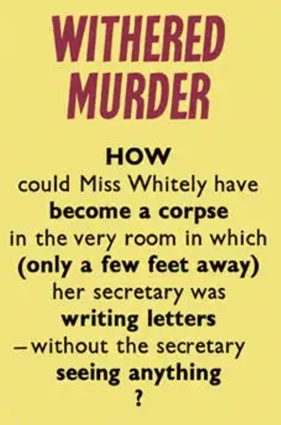
- The impossibility. It is an impossible crime, but the impossibility of the murder happening without being noticed isn’t ever formulated as such. No one really addresses the impossibility of the murder happening without anyone noticing – a plan of the room would have really helped. There’s no discussion of possibilities until the explanation arrives. To be honest, the cover explains it better than the text…
- If Fathom really knew what was happening as he implies he did, then the second death is really unnecessary and cruel.
- The middle third of the book is just suspect by suspect interrogations. If you can cope with Fathom/Verity, then they’re perfectly entertaining, but they don’t exactly add a lot.
The thing is, though, I did enjoy reading this one. Every classic mystery has plot holes but I did find Fathom/Verity annoying. It’s a curiosity rather than a classic, but it’s a huge improvement over the book that preceded it.
 In Search of the Classic Mystery Novel
My 1955 Victor Gollancz edition of Withered Murder has Mr. Fathom, as does my 1957 McMillan edition of How Doth The Little Crocodile.
I definitely agree that the books declined in quality in large part because they started taking Mr. Verity/Fathom seriously as an arbiter of objective justice, rather than a large, loud old man who constantly criticizes other people over things that are frankly none of his business (like the hotel that he chooses to stay at while constantly complaining to the staff about the quality). The Woman in the Wardrobe was superior because it was consistently ridiculous.
LikeLiked by 1 person
Thanks. Looks like he was Fathom in all versions of this one. The copy of Crocodile that I read in the Bodleian had him as Verity.
LikeLike
Your assumption is incorrect. I reviewed this book ten years ago in my blog. I no longer have the book as I sold it around 2020. But this is from my blog post: “In the UK editions he is called Mr. Verity while in the US editions he is renamed Mr. Fathom. Why, I have no idea. But the editors did a sloppy job of the renaming. Fathom’s original name pops up as Verity twice in my edition of Withered Murder which was published the US in 1956.”
LikeLike
So it was the U.K. edition that you had? Because the U.K. edition that I read definitely had him as Fathom throughout.
LikeLike
It was the US edition: Macmillan, 1956. Just like it states in the quoted passage.
LikeLike
Sorry, misread it. So that’s very strange if the only appearance of the Verity name is the US edition, a reversal of what happens in Crocodile…
LikeLike