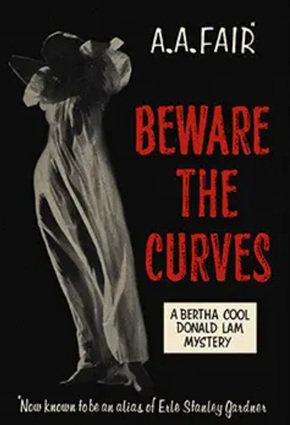
Los Angeles, and private investigators Bertha Cool and Donald Lam have a new client. John Ansel is a writer – apparently – who wants them to track down someone who he once met six years ago in Paris. A seemingly impossible task, but Ansel is convinced that “Karl” came from Citrus Grove in Santa Ana and he has a story to tell that could make him a fortune. Lam can instantly tell that Ansel is lying about almost everything, but looks into the case anyway…
He quickly finds out that the man in question was murdered six years previously and the prime suspect was a fare who was dropped off at his house shortly before the time of death – a man matching Ansel’s description. As Ansel is arrested, Lam finds himself involved in an investigation far more complex than he could have expected. And Bertha Cool’s in the book too…
For a “Cool and Lam” book, I was expecting far more “Cool” in it. For the most part in this one, Bertha Cool seems to be adopting a Dr Priestley/Nero Wolfe type role (although without the insights) . She joins in the action at the end, but Lam is the prime mover in this story.
To explain, this is my first encounter with this series from A A Fair (i.e. Erle Stanley Gardner) – there are thirty in total, starting with The Bigger They Come in 1939 and ending with All Grass Isn’t Green in 1970 (and a lost book, The Knife Slipped, in 2016 – thank you, Jeffrey Marks). I’ve no idea what the balance between the two leads is in the other books, but here Bertha seems to be restricted to coming out with odd turns of phrase whenever Lam reveals something surprising.
It’s an interesting book – I probably read it at the wrong time as I’ve been a bit distracted this week by the thing that teachers spend three years dreading… INSPECTORS! – and so even though this is a short book, I had to read it in short bursts. With the reveals coming thick and fast, I did keep having to remind myself what was going on – especially the zoning ordinance stuff – but I did enjoy the book a lot.
I did wonder though – given how much of the last part is set in the courtroom, and how the denouement is based on an obscure aspect of the law, was this originally a Perry Mason story? Are all of the Cool & Lam books like this?
So, I did enjoy this, but I think I’ll probably be heading back to Perry Mason after this one. But I might be back, so a question for fans of the series? Was this a good place to start? Is it representative of the series or an outlier (especially with the courtroom stuff)? Any information, gratefully received.


I think I’ve read all the Lam & Cool stories, but I’d probably have to check to be sure. Most of the stories tend to focus on Donald Lam, and Bertha more of a supporting character, or really, an “unsupporting” character as she’s usually angry or worried or upset about all the stuff Donald is doing in a case. Although, there’s one or two novels when Donald joined the military (it was during WWII, after all), and Bertha takes a more prominent role in the story. The stories also don’t usually end up in a courtroom like Perry Mason stories do.
LikeLiked by 1 person