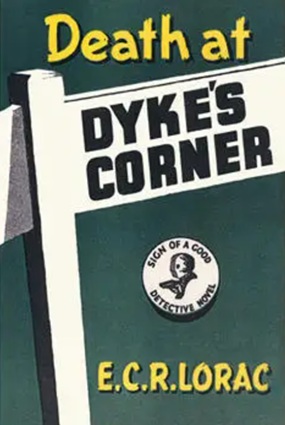
1940, and the town of Strand sees a dead body found in a Daimler, abandoned at Dyke’s Corner, a sharp bend on a dangerous stretch of road. The body belongs to Morton Conyers, a businessman who is the owner of John Home, a chain of stores that threaten to supercede the local small businesses that populate the town. Oh, I didn’t mention – Conyers didn’t crash, but seems to have succumbed to carbon monoxide poisoning from a faulty engine.
The local constabulary are suspicious enough to call in Scotland Yard, in the form of Inspector MacDonald, who swiftly decides that it was murder. But how was the crime committed? Which of the many motives was behind it? And has the killer finished or are more deaths to come?
I was kind enough to be offered the loan of a copy of this one from Ronald Smyth – admittedly, I didn’t realise it would be crossing the Atlantic to get here – following my most recent review of one of Lorac/Carnac’s books. Lorac’s books are a mixed bag for me – some I found fun and clever (A Pall For A Painter, Shroud Of Darkness, When The Devil Was Sick), some full of a wonderful atmosphere (the Lunesdale books) and some… well, some that seem to be trying to be something else.
This opens really well, with two men narrowly avoiding the stranded car and then discovering the body. At this point it seems that this might be Lorac doing a John Rhode impression, but the technicality of the crime is never really part of the story. However the observational story of the town and the struggle of the local shops for local people against the incoming “one size fits all” John Home superstore is reminiscent of the background detail in some of Rhode’s better books, a portrait of an aspect of life lost to time.
And then, when you realise the map is important, along with how much petrol each car had in the tank, which direction they were heading in, etc, it seems as if Freeman Wills Crofts has shown up and persuaded Lorac that she should try her hand at a railway-timetable style mystery.
There’s all sorts of nefarious goings on, especially involving the shopkeepers, but what I felt was missing here was any reason to particularly care about them. It was about halfway through, when the suspicions focus on this lot, that the book lost me.
I found the second half a bit of a slog not caring about the suspects so I don’t rate this as one of her best. You can read a more positive review here at the excellent Window Through Time blog.

