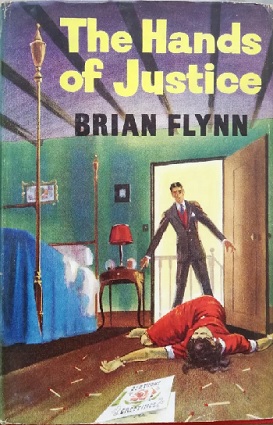
Dr Leo Villon has moved from London to Culverwell, a town in Somerset located on the Bristol Channel. He has taken up a partnership in a GP practice and he and his beautiful wife Stella have settled into their new home and love their new life. Until, of course, tragedy strikes and Leo comes home from a patient visit to find his wife dead. Somebody broke into the house and raped and killed Stella. At that moment, Leo swears that justice – proper justice – will be delivered to the killer and that his hands with be those that deliver that justice.
With barely nothing resembling a clue to the perpetrator – an out of place birthday card and an incomplete dying message – Leo sets up a private investigator agency and, with the help of his new secretary Audrey Manners, he begins to meticulously search for his prey. But the case has also caught the attention of Scotland Yard. And the man they send is Anthony Bathurst…
And so we come to the end of the road, begun when my sister-in-law bought me The Mystery Of The Peacock’s Eye at random for a Christmas present. It’s involved fifty-one other Anthony Bathurst mysteries, one children’s novel and three books from Brian’s pseudonym and now, I’ve come to this – the final, for me, Brian Flynn book to read. I was really looking forward to this – when I read the penultimate (for me) title, The Doll’s Done Dancing, I was pleasantly surprised that such a late book was a great read with a good mystery plot. So, what about this one?
Put it this way – at some point when I get really, really bored, I’m going to rank all fifty-three Brian Flynn titles and just because of how I work, I’ll share it with you. I would be very surprised if this one ranked in the top forty. Ah, who am I kidding, I’m not even convinced it would be in the top fifty.
So what’s wrong with it? Well, there’s hardly any Bathurst in it – I think he’s in three scenes, where he pops up to ask Leo if he’s made progress in finding the killer and gives his thoughts on something resembling a clue. He’s in sagacious mood as every time he makes a suggestion, he is inevitably right. For example, the incomplete dying message is the letters T and A spelled out in matches. Leo assumes that his dying wife was trying to tell him that her killer was tall. Bathurst rattles off a few other adjectives (without really questioning why that is the form of the clue) and needless to say, hits on the right one.
The other problem is that there really isn’t a lot going on, plot-wise. The birthday card implies the villain’s name is also Leo, so a lot of the plot consists of Audrey searching the town in various ways to find anyone who lives there or visited it called Leo. At the end of the day, the villain is cornered by a combination of doggedness and luck, but Flynn basically forgot to include any surprise or twist in the story. The villain is caught, a form of justice happens and… well, that’s it.
The redeeming feature is the interplay with the characters, in particular Audrey who brightens up the book whenever she turns up. Her story arc is odd, to say the least, but she’s a lot of fun, and I could have easily read more about her character.
I wonder – was this a non-Bathurst book that Flynn was made to insert him into? The other book with little Bathurst is Such Bright Disguises but that is much more effective and we actually see him find the truth behind events in that one. Here, the book works without him and his appearances just remind you that he’s a much more entertaining character than Dr Villon.
I also wonder – was Flynn trying to subvert expectations from the reader, by making them guess what was going on and getting it wrong? Look at Leo’s surname – are we supposed to be mulling over if he’s actually the Villon of the piece?
Ah well, with fifty-three books, you’re allowed a couple of duffers… Right, back to the beginning again…
 In Search of the Classic Mystery Novel
I sometimes wonder about Golden Age mystery writers who have a book or books where the series hero only turns up in a few scattered scenes.
Agatha Christie did it in The Hollow and apparently came to regret it, saying that Poirot’s late entrance ruined the book. She inserted him, I think, because she felt that she had to, even though a more caricatured or iconic figure like Hercule Poirot didn’t belong in what’s really a more psychological crime story.
I wonder if Flynn felt a similar pressure. Maybe he was trying to write a psychological thriller but felt pressure from the publishers or readers or even just himself to keep pushing.
LikeLike
Quite possibly. Bathurst’s late appearance in Such Bright Disguised makes sense and works really well – ditto The Creeping Jenny Mystery for different reasons – but here? Maybe Flynn’s contract was to write books featuring Bathurst?
LikeLiked by 1 person