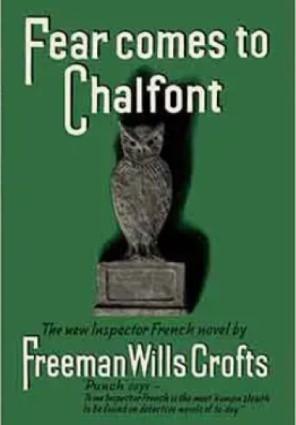
Julia Elton had a difficult life. After being widowed and being left with a daughter when her husband died in a traffic accident, she finds that she is near penniless. She struck a deal with Richard Elton – she would marry him, a marriage of convenience rather than love, and help him with his household and social arrangements. It was hardly an ideal situation, but it was better than being out on the street. It would work fine provided she didn’t fall in love with anyone.
And then she fell in love with someone. As Julia tries to figure out what to do – Elton would never grant a divorce – someone helps her out with a simple solution, namely clobbering Elton over the head with a stone owl. It seems that there is a surfeit of suspects, not least Julia’s paramour, as there seem to be quite a lot of motives flying around. So enter Inspector French…
This is the twenty-third French mystery (I think – the recent reprint lists it as number 19) – no idea why I don’t read them in order. In fact, I’ve no idea why it always takes me an age to revisit Crofts. He’s another example of why whoever dismisses authors as “humdrum” just needs a damned good talking to.
Having said that, this isn’t the best book that I’ve read by the author as it’s a little imbalanced. In a similar way to Sudden Death, each chapter is either focussing on Julia or on Inspector French’s investigations. Julia’s story is intriguing and makes you concerned for her well-being (well, at least hoping she’s not the murderer) and French’s investigations almost feel like conversations with the reader, given form here by Inspector Rollo, recently graduated from Hendon, who French has to show the ropes to (and, interesting, isn’t made out to be an idiot.) The problem is that Julia’s story sort of fizzles out by the end as French gets more and more page time, and a number of plot strands end up being somewhat irrelevant.
It’s an interesting mystery and as ever we follow French theorising and eliminating leads until the truth is nailed down. Rollo is a good foil and there’s a good motive. Not convinced that it’s clued – the bit that gives it away to French really doesn’t feel as if any reader would spot it.
All in all though, another reminder that I need to read more Crofts. This one has been reissued in paperback recently so definitely worth taking a look at.


The British Library published 4 middle period Crofts titles, so Collins haven’t re-issued those. Hence their number 19 is really number 23.
LikeLike
With regard to the “humdrum” comment, the impression that I’ve received from some readers is that is Crofts is a very dry writer without much in the war of atmosphere. But that could be way off base.
LikeLike
I know exactly what you mean. Every now and again I look at my shelves and think “I’ve got rather a lot of Crofts that I haven’t read or haven’t reread in years…” but somehow pick something else. Then, after a while, I do pick one and always find it totally engrossing. I’m a bit less keen on things like 12.30 From Croydon but I still enjoyed that far more than most “inverted” things. Terrific writer, done a huge disservice by the “H” word.
LikeLike