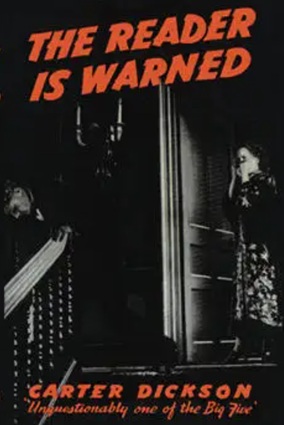
Samuel and Mina Constable request the presence of Dr John Sanders and his friend, Sir Henry Merrivale, as they wish to demonstrate the powers of the psychic Herman Pennik. When Sanders arrives, Pennik almost immediately seems to read some very precise things from his mind – but Pennik has a more deadly prediction to make. That before eight o’clock that evening, Samuel Constable will die.
And that is exactly what happens. With nobody anywhere near him, he drops dead at the top of the main staircase as the clock strikes eight. And then a second such prediction occurs – and death follows that too. Pennik claims to have the power of Teleforce – that, if he has the right connection with people, then he can kill them with his mind. But as Pennik is nowhere near the victims when they die, how is he committing the murders? And if not, why is he taking credit? And what exactly is really going on?
This one came up at Book Club the other day, and I figured I’d re-read it again. It’s been fifteen years and I remember being a bit negative about it when I reviewed it (which in itself was a re-read). I’ll come to the reason that I re-read it in a moment, but let’s take a look at the majority of the book.
It’s part of the sequence of Sir Henry Merrivale tales when the author had settled into writing more… well, more normally structured mysteries, despite the stupendous imagination at play. Gone by now are the multiple, hard to follow, complications of The Unicorn Murders and The Magic Lantern Murders, instead the plots tend to be more straightforward to explain, while still being just as baffling.
This one has the benefit of confusing the reader as to exactly what they are trying to solve – is it Pennik’s method or is it someone else, and if so, what the hell is Pennik up to? – and it has the benefit of a misdirection where Carr doesn’t resort to near-cheating, but uses it not just to misdirect the reader but to actually influence the plot. There’s a second misdirection that long-time Carr readers might fall for as well, but less said about that, the better. Yes, it suffers from a dearth of suspects, so if you’re a guesser, rather than a solver, you might well guess the murderer, but actually putting it all together? No, you won’t do that.
All in all, up to the final chapter, it’s rather magnificent. It’s one of Carr’s most complete books, without a hint of padding, and a really clever plot. There’s also some nice man-in-the-street reactions once the idea of Teleforce becomes public, mostly about killing Hitler with it (note that Britain had not yet declared war at time of writing). But because of that final chapter, I doubt it will ever get reprinted.
I appreciate the racist ideas were of their time, but even so… It’s very uncomfortable reading and I doubt any “do bear in mind that the views expressed in this book were of the time” warning would cover it. I know full well that some books, even with such statements, aren’t averse to trimming the odd adjective here or there, especially when it comes to Jewish stereotypes, but you’d basically have to rewrite a good chunk. Which is such a shame because it wasn’t necessary to the plot to put it in the first place – there are a number of better ways that things could have been explained without it. I appreciate that being a white European that I am not the person to judge the offensiveness of this section, but it seems pretty offensive to me.
If you can find a copy, I do recommend reading this. Copies are out there, but they’re not particularly cheap in the UK. It’s a unique plot structure that Carr handles magnificently. But be prepared for the final chapter and be thankful that times have changed, for the most part at least…


Thank you for this review. I can recall several online reactions to this book, very favorable as a rule, and I was always (at the very least) surprised that they made no mention of the problematic element that you refer to. It seems quite central and unavoidable to me, and I appreciated what you had to say.
LikeLiked by 2 people
I read this a few weeks ago for the first time. Until the bit at the end that slightly damns the book I thought it was probably my favourite book of his. I really rarely it highly but that aspect of the ending was very uncomfortable. I love when Carr goes a little meta and plays with form, as in the nine wrong answers etc. I think it’s so stylish. It all had that gorgeous uncanniness that, for me, is part of his best work. I struggle now to really decide what I think of it. A fantastic and very suddenly flawed read.
LikeLike