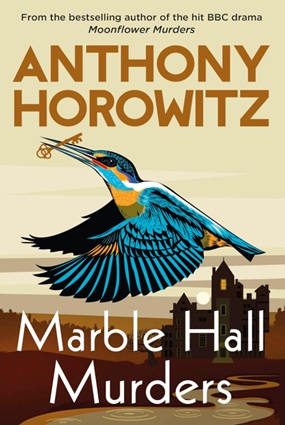
Susan Ryeland has had quite enough of murder, Alan Conway and Atticus Pünd. She’s come close to being killed twice while investigating the secrets that Conway hid inside his novels, and wants nothing more to do with them. But, back in England and in need of money, she receives an offer that she can’t refuse – edit Pünd’s Last Case, a continuation novel that is being written.
But the author, Eliot Crace, is a somewhat disturbed young man, scarred from his life with his grandmother, the children’s author Miriam Crace. Eliot is convinced that Miriam was poisoned, rather than dying from natural causes, and, like Conway before him, he is using Pünd’s Last Case to tell the truth about her murder. But the book isn’t finished yet, and clearly someone doesn’t want it to see print. And it seems that Susan is one of the obstacles that needs to be taken care of.
Well, I thought I’d better get round to reading this before I see some spoilers for the TV adaptation that’s just cropped up on the BBC. This has been sitting on my shelf since Christmas, I think, mocking me with it’s colossal page count. OK, it’s 590 pages, but that’s long for a mystery novel for a little old blogger who wants to cram in as many books as possible every month. But I’ve already clocked up eighteen reviews this month, so I figured I could put aside a few days for this one.
Yeah, I read it in a day. Admittedly, I didn’t do much else that day, but I didn’t want to. Damn, but Horowitz knows what he’s doing. I praised the last Hawthorne mystery , A Deadly Episode, for hiding clues in plain sight and still pulling the wool over my eyes, and, yes, he did it again.
Actually, I did solve a bit of it – I think there are three aspects to work out here, and I definitely figured out one of them. The other two here – in case you haven’t encountered the series before, you have the real-world murder and the book murder to solve – caught me out. Admittedly, the book murder isn’t quite as interesting as the real-world one, but the intricateness of the real world one (which gets a higher page count than the novel) more than compensates. I thought it was damn clever, and I was nowhere near the truth of it.
I won’t say too much else about the book, as I think it’s best read knowing as little as possible, but it’s such an impressive work, both structurally and with regards the characters. Susan’s developing friendship with… someone,,, as problems start piling up is a really nice bit, and I also really enjoyed the erratic character of Eliot, trying to work out what he was up to, and wondering why he was taking such an obtuse way of doing it. I found it a real page-turner, which is a good job due to the number of pages.
It’s quite incredible to think that Horowitz had to rush writing this (apparently) and do the script for the adaptation at basically the same time, because it really doesn’t show. I presume this is the end of the road for Susan Ryeland, but it’s good to see her going out on a high. But maybe never say never…


I bow to nobody in my love of Horowitz but I found this book a bit of a slog. 590 pages! I like to take a paperback on holiday and this came away with me twice to finish it.
So far I’m finding the TV adaptation more enjoyable but also thinking that being familiar with the timelines from the book helps a lot.
LikeLiked by 1 person
I’d heard from people a similar thing, which is why I put off reading it for so long. But I genuinely didn’t find it hard going. There are two full mysteries here, so I’ll let him off the page count.
LikeLike
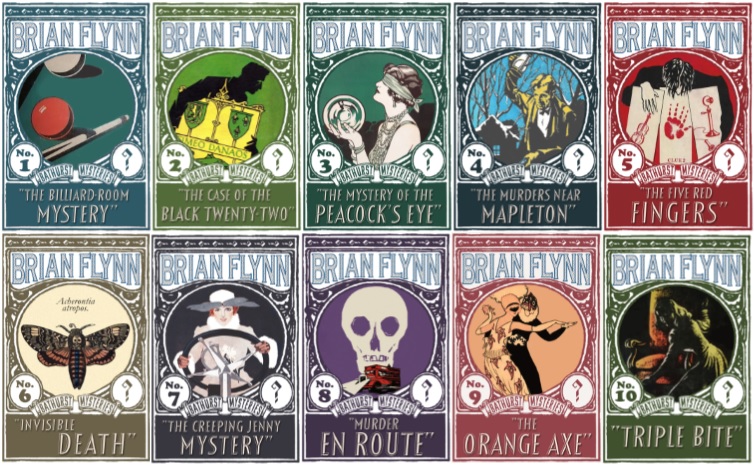
I gave up on the book . A lot of backstory retold and not much action at the start and so many pages. The TV version is also very slow and six episodes. I’ve gone back to watching the second series of “Queens of mystery” and saw an interesting bit of product placement. On display (and later stolen) was a copy of the Brian Flynn No3 reissue and also a rotating rack of the series.
LikeLike
And claiming to be a first edition, iirc… The reason, in part, is that the actress playing the lead in the first series is Brian’s great-granddaughter. In part it was the gift to her from the producers of a copy of The Sharp Quillet that got the family on board for the reprints…
LikeLike
This one disappointed me. I was hoping it was a double-twist and Horowitz was one step ahead, but no. In the third Hawthorne and Horowitz book, there’s a blind character who claims to be psychic, and as a mystery reader I knew from minute one she wasn’t really blind. Just the trope, just the vibe. I knew who the killer was in much the same way. I was just waiting for someone to acknowledge that this character “wasn’t really blind.”
LikeLike
This is the weakest of the 3 imo. reading quickly is probably the way to go.
NOTE: From Horowitz’s AMA on Reddit yesterday:
I’m not sure if there will be more than three seasons on TV but there will definitely be a fourth book: MILE END MURDERS. I’ll start it in a year or two.
LikeLike
I presumed from the last few lines that there would be another. As for the weakest? Yes, possibly, but being the third weakest of three good books doesn’t make it bad. I felt the structure, like the other two, lends itself to long bursts of reading.
LikeLike
I was been really worried that you hadn’t yet reviewed Marble Hall because you didn’t like it (and there had been so many soso reviews about). So I am glad that a) you now have reviewed it and b) given it a big thumbs up! It’ll come off my shelf in the next few days. Thank you PD! Cheers, Michael
LikeLiked by 1 person
It was just the daunting page count. Having said that, from the other comments, I may be in a minority about really enjoying it, but I genuinely loved it.
LikeLike