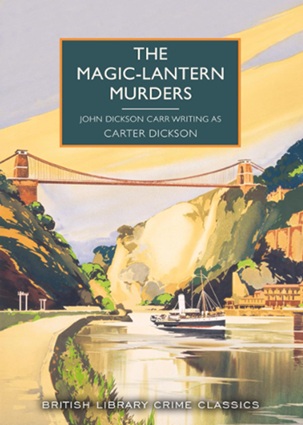
Kenwood Blake is about to get married to the love of his life, Evelyn Cheyne. After meeting and falling in love in the chaos surrounding The Unicorn Murders, both Ken and Evelyn have taken a step back from their work for the government in the espionage department – so the last thing Ken was expecting on the eve of his wedding day was a summons from Sir Henry Merrivale asking his to resume a former alias to head to Torquay to investigate Paul Hogenauer, a local scientist whose work has been overlapping with the occult. Oh, and he’s a German, so he’s probably up to something.
Only he’s not, because when Ken breaks into his house while impersonating a policeman, it transpires that Hogenauer has been poisoned with strychnine. As Ken goes on the run, assisted by Evelyn, they soon find events escalating but it’s going to fall to the Old Man himself to sort everything out…
OK, first of all, don’t read the blurb unless you want to know who the second victim of the killer is, given it happens quite late in the narrative. You have been warned.
Oh, and while we’re on that, there’s a moment where Carr presents us with a fascinating impossibility, only to pull the rug away two pages later. It’s not a cheat, as in some of the tricks he pulls with in books such as Seeing Is Believing (one that I think is hilarious but not everyone agrees), it’s just… well, a bit pointless. Ah well…
Anyway, back to the book (known in the US as The Punch And Judy Murders)… and if you thought bits of The Unicorn Murders was hard to follow, you haven’t seen anything yet. It’s not a typical Carr-ian mystery (although to be honest, I’m not sure what is) but I’d be surprised if anyone reading this as their first Carr would become as obsessed as someone who stumbles across He Who Whispers or Till Death Do Us Part. It’s two-thirds “comedy” romp – it is funny in places but not as entertaining as the author thinks it is – followed by H.M. wasting a fair bit of time with interrogations when he clearly knows who the murderer is at this point.
The killer, as is often the case with Carr, is well-hidden, but in this case, I found their identity unsatisfying, for reasons that would spoil matters. And the less said about Merrivale’s behaviour at the end, the better.
Carr does try this sort of thing at least once more, with The Nine Wrong Answers, and it works better there as there isn’t a Merrivale who needs to eventually show up and solve the thing – in that book, it’s all up to the Ken-equivalent to sort everything out, and I wonder if this one would work better for me if it was just a Ken Blake tale?
The thing is, I can’t review this without the image of other, more traditionally structured, Carr tales in my mind and seeing this fall short. Perhaps that’s unfair – despite H.M. being present, this is a different beast. Has anyone ever encountered this as their first Carr? If so, what did you think of it?
Overall, this is better than a lot of Golden Age mysteries out there, but it’s not going to trouble any Top Ten Carr lists that I make… I gather there’s at least one more Merrivale title coming from the British Library – hopefully that one will be my cup of tea.
Many thanks to the British Library for the review copy.


We are in agreement on exactly six words of your review: “It’s not a typical Carr-Ian mystery.” After that, you’re on your own.
This is one of my favorite Carrs under any name. I appreciate its statindifference from some of the morem”classic” titles. I think it’s hilarious; I only wish Hitchcock had made a film of it because the farce seemed very Hitchcockian. I loved the solution, with a terrific surprise killer. Folks, go read my review!! I cant recommend this highly enough!
LikeLiked by 1 person
WordPress must really value your opinion, as it sent that reply to spam!
Out of curiosity, what are your thoughts on The Unicorn Murders, a similarly overly complicated affair in my opinion?
Readers, here’s the link to Brad’s review – https://ahsweetmystery.com/2019/07/08/acdc-part-six-l-is-for-laughter-in-the-punch-and-judy-murders/ – he raises a number of good points.
LikeLike
I thought The Unicorn Murder had a great premise and some interesting trappings – the trio of HM, Ken Blake and Evelyn were great fun – but the mystery itself proved disappointing. Here’s my review of that one:
https://ahsweetmystery.com/2019/04/07/acdc-part-five-first-lets-talk-about-watsons-the-unicorn-murders/
LikeLiked by 1 person