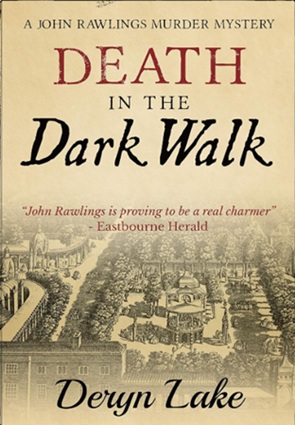
John Rawlings has finished his indenture as an apprentice and is now qualified as an apothecary. As he celebrates in Vaux Hall Pleasure Gardens, as you might expect from the genre, he trips over the body of a dead young woman. Summoned before Sir John Fielding, the Bow Street Magistrate, he finds himself not under suspicion but charged with helping find the woman’s murderer.
When it transpires that the woman was a popular courtesan with many, many clients, Rawlings finds himself bouncing from suspect to suspect – but it seems that the truth behind the woman’s murder may be far less straightforward than a crime of passion…
Following on from Crusader’s War, I thought I’d go on a hunt for a new/overlooked historical mystery writer and first stop was the John Rawlings mysteries by Deryn Lake. There are seventeen of these spread over Rawlings life and they’re set… um, you know what, there’s not a date mentioned in the book. I think it’s set in the reign of George II based on one line (although he could have been mentioned in the past tense). John Fielding being Chief Magistrate and knighted puts it after 1761, but George II died in 1760. Crikey, this is confusing. Let’s say it’s during the early reign of George III.
I’d read Death In The Setting Sun a long time ago and it had some good ideas while still feeling padded. But that was fifteen years ago, maybe things had changed. And besides, the compilation of Books 1 to 10 only cost a quid or two, so I figured it was worth another try.
Oh, hang on, I already did give it a second go – apparently I read Death At The Boston Tea Party, the penultimate title. That was apparently better. I’d forgotten that – that’s not a good sign. Still padded, it seems, by reading the review. At least it does put an upper end to the date for this book – 1773.
So how was the debut book? Well written, apart from date clarity, but… yup, it was pretty padded. The character of John is interesting, even if he does seem to instantly become a super-sleuth. Sir John Fielding, basically doing a Dr Priestley/Nero Wolfe impression, was more interesting to me, but the majority of the plot seemed to have Rawlings going from client to client.
There is a clever idea in the plot, but it does take a while to get to it, and a large part of the investigation has nothing to do with it. If the idea had been expanded throughout the book, this would have been a much more satisfying read. The setting is well constructed and I did like the characters, but the plot, for the third time, was lacking a certain something to make it a great mystery.
Have you read any of the John Rawlings series? Should I stick with it? Or if I haven’t been gripped already, is it not going to happen?
Be back tomorrow for a trip to a different place and time – Ancient Egypt, in fact, but not in the company of Paul Doherty for once. Or Agatha Christie…


I read this one around the time it came out in paperback, mid-nineties, anyway. I can’t remember much about it, other than the Vauxhall setting – but 30-odd years will do that. However, the fact that I didn’t buy any more of them suggests I felt about it much as you do, i.e. OK but not really for me.
LikeLiked by 1 person